--%>

Dominant strategies of Prisoners’ Dilemma

The District Attorney has Car Jacker as well as Cat Burglar nailed for possession of stolen goods after a long crime spree. Now the DA separately offers them the options in this pay-off matrix. When these offers operate only once as well as both of them follow their dominant strategies as: (w) Car Jacker and Cat Burglar each serve four years. (x) Car Jacker serves two years and Cat Burglar serves ten years. (y) Car Jacker and Cat Burglar every serve 6 years. (z) Car Jacker serves 10 years and Cat Burglar serves two years.
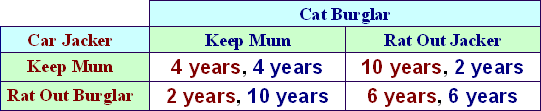
2235_Prisoners Dilemma.png

Can anybody suggest me the proper explanation for given problem regarding Economics generally?

   Related Questions in Game Theory

  • Q : Grim Strategy in Nash Equilibrium A

    A strategy combination where every player is playing a best response to other players' current strategies, and therefore has no incentive to change strategies in a repeating game is termed as: (1) zero-sum equilibrium. (2) the first mover advantage. (3) tit-for-tat. (

  • Q : Dominant strategy for dilemma of

    Into a classic non-repeating prisoner’s dilemma, there dominant strategy for each prisoner is to: (1) confess. (2) follow a grim strategy. (3) engage within predatory behavior. (4) cheat on all agreements with the police. (5) engage during tit-f

  • Q : First Mover Advantage An aggressive

    An aggressive firm which initiates an action in a market most likely perceives a: (1) potential monopoly profit. (2) passive rival which will not react. (3) first mover advantage. (4) gain through a “counterpunch” strategy. (5) possibility

  • Q : Problem regarding to zero sum games

    Making a bet within an office pool on this year’s Kentucky Derby is an illustration of a: (w) positive-sum game. (x) negative-sum game. (y) zero-sum game. (z) tit-for-tat game. Can anybody suggest me the proper explanation fo

  • Q : Example of a positive-sum game An

    An illustration of a positive-sum game could be: wa) trade between two countries according to the law of comparative advantage. (x) a robbery in which $1000 changes hands and no one is hurt. (y) a robbery in which $1000 changes hands and the mugger is

  • Q : Example of a noncooperative game An

    An example of a noncooperative game would be: (1) negotiations for international trade agreements. (2) collective bargaining. (3) plea bargaining. (4) the adoption of tit-for-tat strategies in repeated games. (5) collusion by firms in an oligopoly.

  • Q : Problem regarding to Grim Strategy When

    When after being betrayed by Cameron, Karla holds a grudge forever as well as is nasty to Cameron no issue what Cameron does later to try to make amends, Karla would be pursuing a: (1) burned bridges strategy. (2) tit-for-tat strategy. (3) grim strategy. (4) limited b

  • Q : NOT including competition in

    Illustrations of cooperative games do not comprise: (1) collective bargaining, in which the firms and unions bargain over employment. (2) international treaties that regulate trade. (3) pure competition. (4) plea bargaining between prosecutors and def

  • Q : Potentially affect prices in game theory

    Drew rents strong although nasty bouncers to nightclubs, and also an imperfectly competitive industry. But he knows that his actions potentially influence prices and the market supplies of bouncers, therefore he tries to predict his c

  • Q : Illustration of cooperative game Tom

    Tom and Jill and John are the merely remaining contestants upon the TV show Survivor. Both Tom and Jill secretly collude to divide the million dollars for winning, as well as vote John off the island. Therefore their agreement is an illustration of a: (1) grim strateg