--%>

Follow dominant strategy

If Venezuela and Indonesia could enforce an agreement not to cheat onto OPEC’s cartel quotas: (w) their earnings would be constant since the dominant strategy for both is to not cheat. (x) their earnings would be higher than while they followed the dominant strategy without making an enforceable binding agreement. (y) their earnings may increase or decrease compared to while there was no prior agreement, while there is no dominant strategy. (z) this would be an illustration of a noncooperative game along with a dominant strategy.
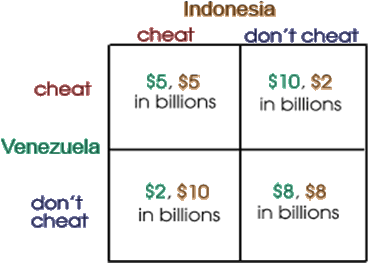
1720_Prisoners’ Dilemma.png

Can someone explain/help me with best solution about problem of Economics...

   Related Questions in Game Theory

  • Q : Grim Strategy in Nash Equilibrium A

    A strategy combination where every player is playing a best response to other players' current strategies, and therefore has no incentive to change strategies in a repeating game is termed as: (1) zero-sum equilibrium. (2) the first mover advantage. (3) tit-for-tat. (

  • Q : Restriction for illustration of

    Illustration of negative sum games would not comprise: (i) violent carjackings. (ii) “winner-take-all” poker games. (iii) war. (iv) retaliatory barriers to international trade. (v) family feuds. Hey fri

  • Q : Problem regarding to Grim Strategy When

    When after being betrayed by Cameron, Karla holds a grudge forever as well as is nasty to Cameron no issue what Cameron does later to try to make amends, Karla would be pursuing a: (1) burned bridges strategy. (2) tit-for-tat strategy. (3) grim strategy. (4) limited b

  • Q : Noncooperative Games ACE and BEST are

    ACE and BEST are the simply two grocery stores within a remote small town into North Dakota. The owners like each other very small and trust each other even less. When they cooperate the Antitrust Division of the U.S. Department of Justice will never know. When both t

  • Q : NO net incentives to change current

    Rivals with no net incentives to modify their current strategies within a repeating sequence of games have arrived at a location of: (1) Nash equilibrium. (2) static churn. (3) classical steady state. (4) the invisible hand. (5) tactical impasse.

  • Q : Problem on Negative Sum Games The

    The bloody American Civil War [from 1861 to 1865] is an illustration of a/an: (1) essential evil. (2) moral hazard. (3) predatory game. (4) involuntary intergenerational transfer. (5) negative sum game. I need a good answer on the

  • Q : Dominant strategies ACE and BEST are

    ACE and BEST are the only two grocery stores into a remote small town within North Dakota. The owners as each other very small, and trust each other even less. When they cooperate the Antitrust Division of the U.S. Department of Justice will never know. Specified this

  • Q : Tit-for-tat behavior for games

    John and Amy have agreed to divide any fudge left over after today. Every time Amy eats a piece of fudge today and also John does, vice versa as well. Their tactics are termed as: (1) grim strategy. (2) tit-for-tat behavior. (3) copy-cat behavior. (4) echoing tactics.

  • Q : Second Mover Strategy Assume that a car

    Assume that a car dealer tries to acquire a prospective buyer to “tell me your highest probable offer for this car, and we will see when that’s acceptable,” although a customer insists, “I will decide whether to buy after you make your lowest p

  • Q : Different charging in Nash equilibrium

    Red Hat wants to increase the power of Linux to attract Windows users. Microsoft is planning Windows Minus, a weaker version to compete with Linux. Each can sell low, medium, or high powered versions of the new software, but each consequently must charge higher, mediu