--%>

Illustrate Dominant Strategy

The dominant strategies in this payoff matrix are for: (w) neither Venezuela nor Indonesia to cheat, thus ensuring that each gets $8 billion profit. (x) both Venezuela and Indonesia to cheat, so receiving $5 billion profit each. (y) the greatest payoff for each country to be realized. (z) Indonesia to not cheat, therefore this earns $8 billion profit, although Venezuela will cheat, as well as earn only a $5 billion profit.
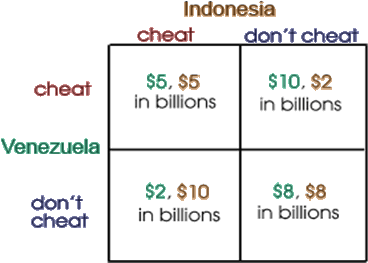
703_Prisoners’ Dilemma.png

Hey friends please give your opinion for the problem of Economics that is given above.

   Related Questions in Game Theory

  • Q : Go to location of strategic companies

    In this payoff matrix for the location strategies of companies, when ACE fails to anticipate the response of BEST and when ACE locates first: (1) they will both go to location 1, just as they would have while BEST had located first. (2) ACE will go to location 1 and B

  • Q : Strategies of companies in go to

    In this payoff matrix for the location strategies of companies, when BEST locates first: (w) both companies will go to location 1. (x) both companies will go to location 2. (y) this will go to location 1 and ACE will go to location 2. (z) this will go to location 2 an

  • Q : Illustration of Second Mover Strategy

    When bartering over a rug in Morocco, Dee rejects to say how much she is willing to pay. In its place she waits for the rug dealer to state a price from that she can bargain. So Dee is using a: (1) first mover strategy. (2) second mover strategy. (3)

  • Q : Study of independent decision Game

    Game theory is about the study of: (w) the utility maximizing behavior of individuals. (x) strategic interactions between interdependent decision makers. (y) independent decision making process of an individual firm. (z) the policy making process of a

  • Q : Illustration of Nash equilibrium As per

    As per this payoff matrix in demonstrated figure, Alyssa going to the football game when Ben attended the play cannot be Nash equilibrium since: (w) they’d each gain the most possible when Ben watched football when Alyssa went to the play. (x) b

  • Q : Tit-for-tat behavior for games

    John and Amy have agreed to divide any fudge left over after today. Every time Amy eats a piece of fudge today and also John does, vice versa as well. Their tactics are termed as: (1) grim strategy. (2) tit-for-tat behavior. (3) copy-cat behavior. (4) echoing tactics.

  • Q : Operates dilemma of prisoner When this

    When this prisoners’ dilemma operates upon a one-time basis, in that case the result is probably to be in the quadrant for: (1) confess; confess. (2) hold out; hold out. (3) Ack-Ack confess; Bongo holdout. (4) Bongo confess; Ack-Ack holdout. (5)

  • Q : NO net incentives to change current

    Rivals with no net incentives to modify their current strategies within a repeating sequence of games have arrived at a location of: (1) Nash equilibrium. (2) static churn. (3) classical steady state. (4) the invisible hand. (5) tactical impasse.

  • Q : Example of Nash equilibrium In this

    In this payoff matrix as in demonstrated figure, when the wife gets to choose first: (w) she will watch the film and her husband will play golf. (x) she will play golf and her husband will go to the movies. (y) they will both play golf. (z) they will both go to the th

  • Q : Infrastructure and decreasing cost

    Assume that government in a developing nation enables start-up some firms to manufacture at lower costs by building infrastructure (for example, power grids and transportation networks), as well as also facilitates learning-by-doing through building p