--%>

Different charging in Nash equilibrium

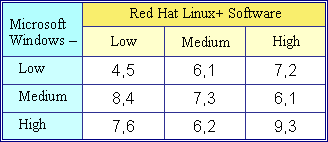
Red Hat wants to increase the power of Linux to attract Windows users. Microsoft is planning Windows Minus, a weaker version to compete with Linux. Each can sell low, medium, or high powered versions of the new software, but each consequently must charge higher, medium, or lower prices for their software. The Nash equilibrium for this payoff matrix is: (a) MS=high, RH = high. (b) MS=medium, RH=low. (c) MS=low, RH=high. (d) MS=high, RH=low. (e) MS=medium, RH=medium.
1337_Nash Equilibrium1.png

Can someone explain/help me with best solution about problem of Economics...

   Related Questions in Game Theory

  • Q : Dominant strategy for dilemma of

    Into a classic non-repeating prisoner’s dilemma, there dominant strategy for each prisoner is to: (1) confess. (2) follow a grim strategy. (3) engage within predatory behavior. (4) cheat on all agreements with the police. (5) engage during tit-f

  • Q : Game theory according to second mover

    Mr. Smith needs someone to mow his lawn and is interviewing a potential lawnmower, Sam. Throughout the interview, there Mr. Smith refuses to tell Sam what wage he is willing to pay Sam till Sam tells him how much he is willing to work for. Mr. Smith is playing a game

  • Q : Flip-flop Strategy in Game Theory

    Famous categories of strategic games do not comprise: (1) grim strategy. (2) tit-for-tat. (3) cooperative games. (4) flip-flop strategy. (5) first mover strategies. How can I solve my Economics pro

  • Q : Result of dilemma of prisoner When

    When Ack-Ack knows that Bongo has connections and will have him killed when he implicates Bongo, in that case the likely result is that: (1) neither prisoner confesses. (2) Bongo pursues a grim strategy. (3) Bongo will do less prison time than Ack-Ack. (4) both prison

  • Q : Problem about Asymmetric Information A

    A large firm knows own costs and the costs of its rival. However a smaller rival firm knows its own costs although is unaware of costs of larger firm. The larger firm is likely to gain due to: (1) industrial concentration. (2) a dominant strategy. (3) predatory practi

  • Q : Policy of Grim Strategy A decisionmaker

    A decisionmaker [i.e., agent in a game] who never forgives other players who failed to cooperate within a previous encounter as well as who punishes them at each opportunity thereafter is pursuing a policy of: (i) motivated vengeance. (i) grim strateg

  • Q : Potentially affect prices in game theory

    Drew rents strong although nasty bouncers to nightclubs, and also an imperfectly competitive industry. But he knows that his actions potentially influence prices and the market supplies of bouncers, therefore he tries to predict his c

  • Q : Problem on Negative Sum Games The

    The bloody American Civil War [from 1861 to 1865] is an illustration of a/an: (1) essential evil. (2) moral hazard. (3) predatory game. (4) involuntary intergenerational transfer. (5) negative sum game. I need a good answer on the

  • Q : Different charging in Nash equilibrium

    Red Hat wants to increase the power of Linux to attract Windows users. Microsoft is planning Windows Minus, a weaker version to compete with Linux. Each can sell low, medium, or high powered versions of the new software, but each consequently must charge higher, mediu

  • Q : Follow the Dominant Strategy Assuming

    Assuming that Venezuela and Indonesia both follow the dominant strategy as: (1) each will earn $8 billion in profit. (2) neither country will cheat. (3) both countries will do better when both cheat. (4) Venezuela will cheat and Indonesia will receive