--%>

Operates dilemma of prisoner

When this prisoners’ dilemma operates upon a one-time basis, in that case the result is probably to be in the quadrant for: (1) confess; confess. (2) hold out; hold out. (3) Ack-Ack confess; Bongo holdout. (4) Bongo confess; Ack-Ack holdout. (5) there is no Nash Equilibrium in this prisoner’s dilemma.
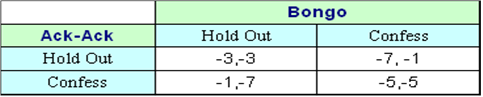
260_Prisoners Dilemma.png

Can someone explain/help me with best solution about problem of Economics...

   Related Questions in Game Theory

  • Q : According to game theory in Nash

    According to game theory, when there are multiple Nash equilibria for a repeated game in that case: (w) once one Nash is selected this will be maintained, and all else constant. (x) any Nash equilibrium may be chosen as the first equi

  • Q : Problem on Nash equilibrium Alyssa and

    Alyssa and Ben are trying to decide where to go to the football game or to the play. But Alyssa prefers the play and Ben the ball game, although they’d prefer to do somewhat together. The Nash equilibrium is: (w) Alyssa goes to the play and Ben

  • Q : Study of independent decision Game

    Game theory is about the study of: (w) the utility maximizing behavior of individuals. (x) strategic interactions between interdependent decision makers. (y) independent decision making process of an individual firm. (z) the policy making process of a

  • Q : NO net incentives to change current

    Rivals with no net incentives to modify their current strategies within a repeating sequence of games have arrived at a location of: (1) Nash equilibrium. (2) static churn. (3) classical steady state. (4) the invisible hand. (5) tactical impasse.

  • Q : Example of positive sum games Happy

    Happy marriages are illustrations of: (i) mutual independence. (ii) specialization according to comparative advantage. (iii) positive sum games. (iv) the prisoners’ dilemma. (v) first mover advantages. I need a good answer on

  • Q : Tit-for-tat behavior for games

    John and Amy have agreed to divide any fudge left over after today. Every time Amy eats a piece of fudge today and also John does, vice versa as well. Their tactics are termed as: (1) grim strategy. (2) tit-for-tat behavior. (3) copy-cat behavior. (4) echoing tactics.

  • Q : Explain Nash equilibrium with an example

    In this payoff matrix as in illustrated, when the husband gets to choose first: (w) he will watch the film and his wife will play golf. (x) he will play golf and his wife will see the film. (y) they will both play golf. (z) they will both see the film.

    Q : Example of Nash equilibrium In this

    In this payoff matrix as in demonstrated figure, when the wife gets to choose first: (w) she will watch the film and her husband will play golf. (x) she will play golf and her husband will go to the movies. (y) they will both play golf. (z) they will both go to the th

  • Q : Problem about Asymmetric Information A

    A large firm knows own costs and the costs of its rival. However a smaller rival firm knows its own costs although is unaware of costs of larger firm. The larger firm is likely to gain due to: (1) industrial concentration. (2) a dominant strategy. (3) predatory practi

  • Q : Repeating game in Nash equilibrium In

    In Nash equilibrium for a repeating game, there the participants: (i) share potential gains in proportion to the relative sizes of the two parties. (ii) are harmed by the prisoners’ dilemma. (iii) have both adopted their respective dominant posi