--%>

Illustration of Prisoners ‘Dilemma

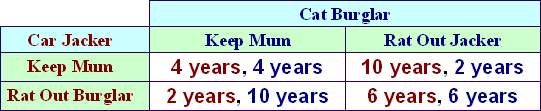
The District Attorney has Car Jacker as well as Cat Burglar nailed for possession of stolen goods after a long crime spree. Now the DA separately offers them the options within this pay-off matrix. The probably result is for: (1) Car Jacker to serve only two years because he rats out Cat Burglar, who serves 10 years. (2) Car Jacker serves two years and Cat Burglar serves ten years. (3) Cat Burglar to serve only two years because he rats out Car Jacker, who serves 10 years. (4) Car Jacker and Cat Burglar to each rat-out the other, and both serve 6 years. (5) Car Jacker and Cat Burglar to both get life sentences as habitual third-strike criminals.
1567_Prisoners Dilemma.png

I need a good answer on the topic of Economics problems. Please give me your suggestion for the same by using above options.

   Related Questions in Game Theory

  • Q : Problem on Negative Sum Games The

    The bloody American Civil War [from 1861 to 1865] is an illustration of a/an: (1) essential evil. (2) moral hazard. (3) predatory game. (4) involuntary intergenerational transfer. (5) negative sum game. I need a good answer on the

  • Q : Problem regarding Prisoners’ Dilemma

    The District Attorney has Car Jacker and also Cat Burglar nailed for possession of stolen goods after a long crime spree. Now the DA separately gives them the options in this pay-off matrix. Even though these offers operate only once, when Car Jacker and Cat Burglar a

  • Q : Dominant strategies of Prisoners’

    The District Attorney has Car Jacker as well as Cat Burglar nailed for possession of stolen goods after a long crime spree. Now the DA separately offers them the options in this pay-off matrix. When these offers operate only once as well as both of them follow their <

  • Q : Repeating game in Nash equilibrium In

    In Nash equilibrium for a repeating game, there the participants: (i) share potential gains in proportion to the relative sizes of the two parties. (ii) are harmed by the prisoners’ dilemma. (iii) have both adopted their respective dominant posi

  • Q : Tit-for-Tat behavior The tit-for-tat

    The tit-for-tat behavior that frequently emerges in an infinitely repeated game may be summarized as do unto others like: (w) they most recently did unto you. (x) you would have them do unto you. (y) before they do unto you. (z) they have ever done un

  • Q : Prisoner's dilemma game theory This

    This payoff matrix as in demonstrated figure for two countries that belong to the OPEC cartel exemplifies: (w) a prisoner's dilemma game. (x) a game in which neither participant has a dominant strategy. (y) why neither country will cheat as a dominant

  • Q : Tit-for-Tat in Dynamic Games Assume

    Assume that Kevin and Margeaux play a repeated game in that they can choose to act either cooperatively or non cooperatively. When on the third round, Kevin reacts cooperatively and Margeaux react uncooperatively: (1) and both use tit-for-tat strategy

  • Q : Competitive prices and efficiency and

    When all industries were purely competitive and externalities were not present and when the distribution of income was viewed as fair by consensus of the population, in that case the marginal value to society of an extra unit of a goo

  • Q : Exemplify Zero-Sum Game Making a bet

    Making a bet within an office pool on this year's Super Bowl is an illustration of a: (w) positive-sum game. (x) negative-sum game. (y) zero-sum game. (z) communal sacrifice. I need a good answer on the topic of Economics <

  • Q : Dominant strategy for dilemma of

    Into a classic non-repeating prisoner’s dilemma, there dominant strategy for each prisoner is to: (1) confess. (2) follow a grim strategy. (3) engage within predatory behavior. (4) cheat on all agreements with the police. (5) engage during tit-f