--%>

Problem regarding Prisoners’ Dilemma

The District Attorney has Car Jacker and also Cat Burglar nailed for possession of stolen goods after a long crime spree. Now the DA separately gives them the options in this pay-off matrix. Even though these offers operate only once, when Car Jacker and Cat Burglar are brothers who love as well as trust each other, the probably result would be that: (w) Car Jacker and Cat Burglar would both stay silent and each would serve four years. (x) Car Jacker serves two years and Cat Burglar serves ten years. (y) Car Jacker and Cat Burglar would each rat out the other and serve six years. (z) Car Jacker serves ten years and Cat Burglar serves two years.
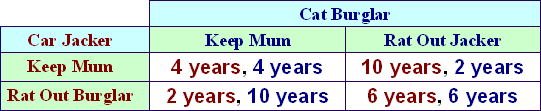
722_Prisoners Dilemma.png

Please help me to solve the problem of Economic that is given above.

   Related Questions in Game Theory

  • Q : Strategies of companies in go to

    In this payoff matrix for the location strategies of companies, when BEST locates first: (w) both companies will go to location 1. (x) both companies will go to location 2. (y) this will go to location 1 and ACE will go to location 2. (z) this will go to location 2 an

  • Q : Illustration of Second Mover Strategy

    When bartering over a rug in Morocco, Dee rejects to say how much she is willing to pay. In its place she waits for the rug dealer to state a price from that she can bargain. So Dee is using a: (1) first mover strategy. (2) second mover strategy. (3)

  • Q : Illustrations of cooperative games An

    An instant of a noncooperative game would be: (w) consequences for non-confessors in a classic prisoner’s dilemma. (x) collective bargaining. (y) courtship and marriage. (z) plea bargaining. Can someone expla

  • Q : Tit-for-tat behavior for games

    John and Amy have agreed to divide any fudge left over after today. Every time Amy eats a piece of fudge today and also John does, vice versa as well. Their tactics are termed as: (1) grim strategy. (2) tit-for-tat behavior. (3) copy-cat behavior. (4) echoing tactics.

  • Q : Tit-for-Tat behavior The tit-for-tat

    The tit-for-tat behavior that frequently emerges in an infinitely repeated game may be summarized as do unto others like: (w) they most recently did unto you. (x) you would have them do unto you. (y) before they do unto you. (z) they have ever done un

  • Q : Grim Strategy When Tia would respond by

    When Tia would respond by never again cooperating within a long sequence of repeated transaction when Carmen ever failed to cooperate, in that case Tia would be following: (1) Nash equilibrium. (2) tit-for-tat. (3) domino strategy. (4) grim strategy. (5) cut-throat co

  • Q : Dominant strategy for dilemma of

    Into a classic non-repeating prisoner’s dilemma, there dominant strategy for each prisoner is to: (1) confess. (2) follow a grim strategy. (3) engage within predatory behavior. (4) cheat on all agreements with the police. (5) engage during tit-f

  • Q : Prisoner's dilemma game theory This

    This payoff matrix as in demonstrated figure for two countries that belong to the OPEC cartel exemplifies: (w) a prisoner's dilemma game. (x) a game in which neither participant has a dominant strategy. (y) why neither country will cheat as a dominant

  • Q : Game theory according to oligopolists

    The game theory approach supposes that oligopolists: (w) do not maximize profit. (x) act strategically. (y) are actually monopolists in disguise. (z) maximize revenue. I need a good answer on the t

  • Q : Example of a noncooperative game An

    An example of a noncooperative game would be: (1) negotiations for international trade agreements. (2) collective bargaining. (3) plea bargaining. (4) the adoption of tit-for-tat strategies in repeated games. (5) collusion by firms in an oligopoly.