--%>

Strategies of companies in go to location

In this payoff matrix for the location strategies of companies, when BEST locates first: (w) both companies will go to location 1. (x) both companies will go to location 2. (y) this will go to location 1 and ACE will go to location 2. (z) this will go to location 2 and ACE will go to location 1.
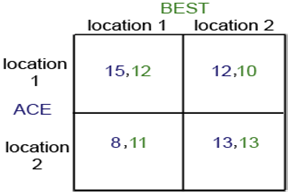
1626_Problem regarding Nash Equilibrium.png

Hello guys I want your advice. Please recommend some views for above Economics problems.

   Related Questions in Game Theory

  • Q : Game Theory and Oligopoly Economists

    Economists would be probably to apply game theory to the market structure of: (1) oligopoly. (2) perfect competition. (3) pure monopoly. (4) labor unions. (5) monopolistic competition. Please choos

  • Q : Experience decreasing costs industry If

    If one industry’s development stimulates development in support and complementary industries, it permits firms within the industry to: (i) move up their rising long run average costs curves. (ii) sell their products for higher prices. (iii) focus old technologie

  • Q : Problem on positive sum game When two

    When two countries decide to involve in trade because of comparative advantage: (w) one country will gain more than the other. (x) there should be completely free trade for both countries to benefit. (y) the overall consequences for all consumers can be explained as a

  • Q : Illustrations of cooperative games An

    An instant of a noncooperative game would be: (w) consequences for non-confessors in a classic prisoner’s dilemma. (x) collective bargaining. (y) courtship and marriage. (z) plea bargaining. Can someone expla

  • Q : Problem about Second-Mover Strategy A

    A boxer who is a counterpuncher within place of an aggressor is subsequent a: (1) second-mover strategy. (2) grim strategy. (3) prisoner’s dilemma strategy. (4) rebound strategy. (5) copy-cat strategy. I need a good answer on

  • Q : First Mover Advantage An aggressive

    An aggressive firm which initiates an action in a market most likely perceives a: (1) potential monopoly profit. (2) passive rival which will not react. (3) first mover advantage. (4) gain through a “counterpunch” strategy. (5) possibility

  • Q : Example of positive sum games Happy

    Happy marriages are illustrations of: (i) mutual independence. (ii) specialization according to comparative advantage. (iii) positive sum games. (iv) the prisoners’ dilemma. (v) first mover advantages. I need a good answer on

  • Q : Restriction for illustration of

    Illustration of negative sum games would not comprise: (i) violent carjackings. (ii) “winner-take-all” poker games. (iii) war. (iv) retaliatory barriers to international trade. (v) family feuds. Hey fri

  • Q : Game theory according to oligopolists

    The game theory approach supposes that oligopolists: (w) do not maximize profit. (x) act strategically. (y) are actually monopolists in disguise. (z) maximize revenue. I need a good answer on the t

  • Q : Noncooperative Games ACE and BEST are

    ACE and BEST are the simply two grocery stores within a remote small town into North Dakota. The owners like each other very small and trust each other even less. When they cooperate the Antitrust Division of the U.S. Department of Justice will never know. When both t