--%>

Go to location of strategic companies

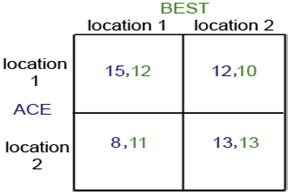
In this payoff matrix for the location strategies of companies, when ACE fails to anticipate the response of BEST and when ACE locates first: (1) they will both go to location 1, just as they would have while BEST had located first. (2) ACE will go to location 1 and BEST will go to location 2. (3) they will both go to location 2, just as they would have while BEST had located first. (4) ACE will go to location 2 and BEST will go to location 1. (5) they will both go to location 2.
2439_Problem regarding Nash Equilibrium.png


Can someone explain/help me with best solution about problem of Economics...

   Related Questions in Game Theory

  • Q : Problem on positive sum game When two

    When two countries decide to involve in trade because of comparative advantage: (w) one country will gain more than the other. (x) there should be completely free trade for both countries to benefit. (y) the overall consequences for all consumers can be explained as a

  • Q : Second Mover Advantage India asserts

    India asserts which this will begin disarming only after Pakistan begins to disarm. Policy of India reflects belief in: (1) mutually assured destruction. (2) second mover advantage. (3) predatory behavior. (4) accommodation. (5) single play strategy.

    Q : Tit-for-Tat behavior The tit-for-tat

    The tit-for-tat behavior that frequently emerges in an infinitely repeated game may be summarized as do unto others like: (w) they most recently did unto you. (x) you would have them do unto you. (y) before they do unto you. (z) they have ever done un

  • Q : Game theory according to oligopolists

    The game theory approach supposes that oligopolists: (w) do not maximize profit. (x) act strategically. (y) are actually monopolists in disguise. (z) maximize revenue. I need a good answer on the t

  • Q : Result of dilemma of prisoner When

    When Ack-Ack knows that Bongo has connections and will have him killed when he implicates Bongo, in that case the likely result is that: (1) neither prisoner confesses. (2) Bongo pursues a grim strategy. (3) Bongo will do less prison time than Ack-Ack. (4) both prison

  • Q : Tit-for-Tat in Dynamic Games Assume

    Assume that Kevin and Margeaux play a repeated game in that they can choose to act either cooperatively or non cooperatively. When on the third round, Kevin reacts cooperatively and Margeaux react uncooperatively: (1) and both use tit-for-tat strategy

  • Q : Policy of Grim Strategy A decisionmaker

    A decisionmaker [i.e., agent in a game] who never forgives other players who failed to cooperate within a previous encounter as well as who punishes them at each opportunity thereafter is pursuing a policy of: (i) motivated vengeance. (i) grim strateg

  • Q : Divide total profit with profit

    Red Hat wants to raise the power of Linux to attract Windows all users. Therefore Microsoft is planning Windows Minus, a weaker version to compete along with Linux. All can sell low, medium or high powered versions of the new software, although each consequently shoul

  • Q : Problem regarding on positive-sum game

    International trade confronted by no tariffs or quotas therefore this is based upon comparative advantage is an example of a: (1) positive-sum game. (2) tit-for-tat game. (3) negative-sum game. (4) zero-sum game. (5) strategic game. Can anybody suggest me the proper expla

  • Q : Problem regarding Prisoners’ Dilemma

    The District Attorney has Car Jacker and also Cat Burglar nailed for possession of stolen goods after a long crime spree. Now the DA separately gives them the options in this pay-off matrix. Even though these offers operate only once, when Car Jacker and Cat Burglar a