--%>

Illustration of Nash equilibrium

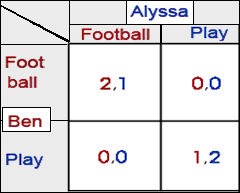
As per this payoff matrix in demonstrated figure, Alyssa going to the football game when Ben attended the play cannot be Nash equilibrium since: (w) they’d each gain the most possible when Ben watched football when Alyssa went to the play. (x) by both going to the play or both to the ball game, they are both better off. (y) attending the play generates disutility for Ben. (z) Ben hates the concept of going to the play, as well as Alyssa hates the crowd noise in football games.
1880_Nash Equilibrium.png

How can I solve my Economics problem? Please suggest me the correct answer.

   Related Questions in Game Theory

  • Q : Game Theory and Oligopoly Economists

    Economists would be probably to apply game theory to the market structure of: (1) oligopoly. (2) perfect competition. (3) pure monopoly. (4) labor unions. (5) monopolistic competition. Please choos

  • Q : Asymmetric Information If two firms

    If two firms considering a possible merger have unequal levels of knowledge regarding issues in their negotiations: (w) potential abuses of asymmetric information exist. (x) the payoff matrix is invariably asymmetric. (y) the more knowledgeable negotiator will gain by

  • Q : Problem on Nash equilibrium Alyssa and

    Alyssa and Ben are trying to decide where to go to the football game or to the play. But Alyssa prefers the play and Ben the ball game, although they’d prefer to do somewhat together. The Nash equilibrium is: (w) Alyssa goes to the play and Ben

  • Q : Oligopolists in Game Theory John von

    John von Neumann and Oskar Morgenstern utilized heavy doses of mathematics to analyze diverse strategies in between rival institutions, including oligopolists, if they developed: (1) a systematic approach to research and development [R and D]. (2) dom

  • Q : Experience decreasing costs industry If

    If one industry’s development stimulates development in support and complementary industries, it permits firms within the industry to: (i) move up their rising long run average costs curves. (ii) sell their products for higher prices. (iii) focus old technologie

  • Q : Strategies of companies in go to

    In this payoff matrix for the location strategies of companies, when BEST locates first: (w) both companies will go to location 1. (x) both companies will go to location 2. (y) this will go to location 1 and ACE will go to location 2. (z) this will go to location 2 an

  • Q : Example of positive sum games Happy

    Happy marriages are illustrations of: (i) mutual independence. (ii) specialization according to comparative advantage. (iii) positive sum games. (iv) the prisoners’ dilemma. (v) first mover advantages. I need a good answer on

  • Q : NOT including competition in

    Illustrations of cooperative games do not comprise: (1) collective bargaining, in which the firms and unions bargain over employment. (2) international treaties that regulate trade. (3) pure competition. (4) plea bargaining between prosecutors and def

  • Q : Illustration of a Zero-Sum Game An

    An illustration of a zero-sum game is: (w) a baseball game. (bx) a mugging. (y) a cartel. (z) the prisoner's dilemma. Can anybody suggest me the proper explanation for given problem regarding Economics

  • Q : Policy of Grim Strategy A decisionmaker

    A decisionmaker [i.e., agent in a game] who never forgives other players who failed to cooperate within a previous encounter as well as who punishes them at each opportunity thereafter is pursuing a policy of: (i) motivated vengeance. (i) grim strateg