--%>

Explain Nash equilibrium with an example

In this payoff matrix as in illustrated, when the husband gets to choose first: (w) he will watch the film and his wife will play golf. (x) he will play golf and his wife will see the film. (y) they will both play golf. (z) they will both see the film.
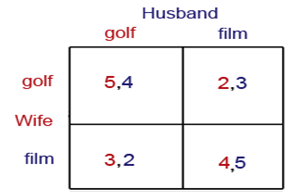
240_Nash Equilibrium.png

I need a good answer on the topic of Economics problems. Please give me your suggestion for the same by using above options.

   Related Questions in Game Theory

  • Q : Problem about Second-Mover Strategy A

    A boxer who is a counterpuncher within place of an aggressor is subsequent a: (1) second-mover strategy. (2) grim strategy. (3) prisoner’s dilemma strategy. (4) rebound strategy. (5) copy-cat strategy. I need a good answer on

  • Q : Illustration of Nash equilibrium As per

    As per this payoff matrix in demonstrated figure, Alyssa going to the football game when Ben attended the play cannot be Nash equilibrium since: (w) they’d each gain the most possible when Ben watched football when Alyssa went to the play. (x) b

  • Q : Repeating game in Nash equilibrium In

    In Nash equilibrium for a repeating game, there the participants: (i) share potential gains in proportion to the relative sizes of the two parties. (ii) are harmed by the prisoners’ dilemma. (iii) have both adopted their respective dominant posi

  • Q : Example of a noncooperative game An

    An example of a noncooperative game would be: (1) negotiations for international trade agreements. (2) collective bargaining. (3) plea bargaining. (4) the adoption of tit-for-tat strategies in repeated games. (5) collusion by firms in an oligopoly.

  • Q : Example of a second mover strategy An

    An instance of a second mover strategy would be a: (1) baseball manager waiting till the other team's manager inserts a pinch hitter before selecting a relief pitcher. (2) firm's decision to lay-off workers. (3) union going on strike while a labor con

  • Q : First Mover Advantage An aggressive

    An aggressive firm which initiates an action in a market most likely perceives a: (1) potential monopoly profit. (2) passive rival which will not react. (3) first mover advantage. (4) gain through a “counterpunch” strategy. (5) possibility

  • Q : Example of a positive-sum game An

    An illustration of a positive-sum game could be: wa) trade between two countries according to the law of comparative advantage. (x) a robbery in which $1000 changes hands and no one is hurt. (y) a robbery in which $1000 changes hands and the mugger is

  • Q : Experience decreasing costs industry If

    If one industry’s development stimulates development in support and complementary industries, it permits firms within the industry to: (i) move up their rising long run average costs curves. (ii) sell their products for higher prices. (iii) focus old technologie

  • Q : Outcome for an infinitely repeated game

    One probable outcome for an infinitely repeated game is termed as the: (w) Middle East strategy. (x) tit-for-tat strategy. (y) echo strategy. (z) prisoners' dilemma strategy. How can I solve my Economics

  • Q : Tit-for-Tat behavior The tit-for-tat

    The tit-for-tat behavior that frequently emerges in an infinitely repeated game may be summarized as do unto others like: (w) they most recently did unto you. (x) you would have them do unto you. (y) before they do unto you. (z) they have ever done un