--%>

Dominant strategies

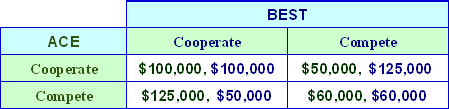
ACE and BEST are the only two grocery stores into a remote small town within North Dakota. The owners as each other very small, and trust each other even less. When they cooperate the Antitrust Division of the U.S. Department of Justice will never know. Specified this payoff matrix for ACE and BEST, the dominant strategies: (w) are for neither grocery store to cooperate. (x) are for both stores to cooperate, therefore ensuring that each will make $60,000 annually. (y) will guarantee the greatest total payoff for both stores. (z) should yield similar outcome regardless of how many times these firms play this “game.”
2310_Prisoners Dilemma1.png

I need a good answer on the topic of Economics problems. Please give me your suggestion for the same by using above options.

   Related Questions in Game Theory

  • Q : Restriction for illustration of

    Illustration of negative sum games would not comprise: (i) violent carjackings. (ii) “winner-take-all” poker games. (iii) war. (iv) retaliatory barriers to international trade. (v) family feuds. Hey fri

  • Q : Strategies of companies for Nash

    In this payoff matrix for the location strategies of companies: (w) BEST will choose to go to location 1 and ACE will choose to go to location 2. (x) BEST will choose to go to location 2 and ACE will choose to go to location 1. (y) there is no Nash equilibrium. (z) th

  • Q : Problem regarding on positive-sum game

    International trade confronted by no tariffs or quotas therefore this is based upon comparative advantage is an example of a: (1) positive-sum game. (2) tit-for-tat game. (3) negative-sum game. (4) zero-sum game. (5) strategic game. Can anybody suggest me the proper expla

  • Q : Grim Strategy When Tia would respond by

    When Tia would respond by never again cooperating within a long sequence of repeated transaction when Carmen ever failed to cooperate, in that case Tia would be following: (1) Nash equilibrium. (2) tit-for-tat. (3) domino strategy. (4) grim strategy. (5) cut-throat co

  • Q : Problem about Second-Mover Strategy A

    A boxer who is a counterpuncher within place of an aggressor is subsequent a: (1) second-mover strategy. (2) grim strategy. (3) prisoner’s dilemma strategy. (4) rebound strategy. (5) copy-cat strategy. I need a good answer on

  • Q : Oligopolists in Game Theory John von

    John von Neumann and Oskar Morgenstern utilized heavy doses of mathematics to analyze diverse strategies in between rival institutions, including oligopolists, if they developed: (1) a systematic approach to research and development [R and D]. (2) dom

  • Q : Tit-for-Tat behavior The tit-for-tat

    The tit-for-tat behavior that frequently emerges in an infinitely repeated game may be summarized as do unto others like: (w) they most recently did unto you. (x) you would have them do unto you. (y) before they do unto you. (z) they have ever done un

  • Q : Tit-for-tat behavior for games

    John and Amy have agreed to divide any fudge left over after today. Every time Amy eats a piece of fudge today and also John does, vice versa as well. Their tactics are termed as: (1) grim strategy. (2) tit-for-tat behavior. (3) copy-cat behavior. (4) echoing tactics.

  • Q : Application of game theory Within the

    Within the application of game theory, in that case the payoff is: (w) the game’s outcome. (x) the rival firm’s actions. (y) a consequence only of one firm’s actions. (z) is always uncertain. How

  • Q : Example of positive sum games Happy

    Happy marriages are illustrations of: (i) mutual independence. (ii) specialization according to comparative advantage. (iii) positive sum games. (iv) the prisoners’ dilemma. (v) first mover advantages. I need a good answer on