--%>

Strategies of companies for Nash Equilibrium

In this payoff matrix for the location strategies of companies: (w) BEST will choose to go to location 1 and ACE will choose to go to location 2. (x) BEST will choose to go to location 2 and ACE will choose to go to location 1. (y) there is no Nash equilibrium. (z) there are two Nash equilibria.
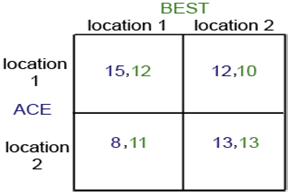
1499_Problem regarding Nash Equilibrium.png

Hey friends please give your opinion for the problem of Economics that is given above.

   Related Questions in Game Theory

  • Q : Illustration of cooperative game Tom

    Tom and Jill and John are the merely remaining contestants upon the TV show Survivor. Both Tom and Jill secretly collude to divide the million dollars for winning, as well as vote John off the island. Therefore their agreement is an illustration of a: (1) grim strateg

  • Q : Decreasing cost industries When average

    When average production cost for Plastibristle Inc. falls like market demand increases and more firms go into the industry, Plastibristle is within:  (1) an economically efficient industry. (2) a purely competitive industry. (3) an industry exper

  • Q : Example of a second mover strategy An

    An instance of a second mover strategy would be a: (1) baseball manager waiting till the other team's manager inserts a pinch hitter before selecting a relief pitcher. (2) firm's decision to lay-off workers. (3) union going on strike while a labor con

  • Q : Example of a positive-sum game An

    An illustration of a positive-sum game could be: wa) trade between two countries according to the law of comparative advantage. (x) a robbery in which $1000 changes hands and no one is hurt. (y) a robbery in which $1000 changes hands and the mugger is

  • Q : Problem regarding to zero sum games

    Making a bet within an office pool on this year’s Kentucky Derby is an illustration of a: (w) positive-sum game. (x) negative-sum game. (y) zero-sum game. (z) tit-for-tat game. Can anybody suggest me the proper explanation fo

  • Q : Problem about Second-Mover Strategy A

    A boxer who is a counterpuncher within place of an aggressor is subsequent a: (1) second-mover strategy. (2) grim strategy. (3) prisoner’s dilemma strategy. (4) rebound strategy. (5) copy-cat strategy. I need a good answer on

  • Q : Repeating game in Nash equilibrium In

    In Nash equilibrium for a repeating game, there the participants: (i) share potential gains in proportion to the relative sizes of the two parties. (ii) are harmed by the prisoners’ dilemma. (iii) have both adopted their respective dominant posi

  • Q : NO net incentives to change current

    Rivals with no net incentives to modify their current strategies within a repeating sequence of games have arrived at a location of: (1) Nash equilibrium. (2) static churn. (3) classical steady state. (4) the invisible hand. (5) tactical impasse.

  • Q : First Mover Advantage An aggressive

    An aggressive firm which initiates an action in a market most likely perceives a: (1) potential monopoly profit. (2) passive rival which will not react. (3) first mover advantage. (4) gain through a “counterpunch” strategy. (5) possibility

  • Q : Go to location of strategic companies

    In this payoff matrix for the location strategies of companies, when ACE fails to anticipate the response of BEST and when ACE locates first: (1) they will both go to location 1, just as they would have while BEST had located first. (2) ACE will go to location 1 and B