--%>

What is synthetic rubber and how it gets prepared?

To meet human needs, scientists have started preparing synthetic rubbers. Besides having similar properties as natural rubbers they are tougher, more flexible and more durable than natural rubber. They are capable of getting stretched to twice its length. Though, it reverts to its original shape and size once the external stretching force is released.


Synthetic rubbers have been made by the polymerisation of dienes other than isoprene. The polymerisation is carried out in the presence of Zeigher-Natta catalyst. For example, Polymerisation of 1, 3-butadiene

Preparation of synthetic rubbers

1. Neoprene or polychloro prene is formed by the free radical polymerisation of chloroprene.

It has superior resistance to vegetable and mineral oils. It is used for manufacturing of conveyer belts, gaskets and hoses.

2. Buna-N: you have previously studied about Buna-S. Buna-N is obtained by the copolymerization of 1, 3-butadiene and Acrylonitrile in the presence of a peroxide catalyst.
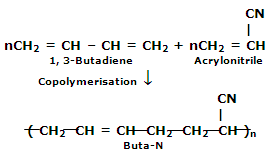
2175_synthetic rubber.png 

It is resistant to the reaction of petrol, lubricating oil and organic solvents. It is utilized in making oil seals, tank lining etc.


   Related Questions in Chemistry

  • Q : Explain Vapour Pressure Composition A

    A pressure composition diagram for a liquid vapor system can be used to show the composition of the liquid and equilibrium vapor.Vapor equilibrium data are useful in the study of distillations. It is of value to have diagrams showing not only the vapor pre

  • Q : Oxoacids of halogens Why oxidising

    Why oxidising character of oxoacids of halogens decreases as oxidation number increases?

  • Q : Colligative property associated question

    Give me answer of this question. Which of the following is not a colligative property : (a)Optical activity (b)Elevation in boiling point (c)Osmotic pressure (d)Lowering of vapour pressure

  • Q : Short note on the function of

    Write down a short note on the function of mitochondria?

  • Q : Strength of the Hydrochloric acid

    Provide solution of this question. 1.0 gm of pure calcium carbonate was found to need 50 ml of dilute HCL for complete reaction. The strength of the HCL solution is specified by : (a) 4 N (b) 2 N (c) 0.4 N (d) 0.2 N

  • Q : Base parachloroaniline is strong base

    parachloroaniline is strong base than paranitroaniline

  • Q : Calculation of molecular weight Provide

    Provide solution of this question. In an experiment, 1 g of a non-volatile solute was dissolved in 100 g of acetone (mol. mass = 58) at 298K. The vapour pressure of the solution was found to be 192.5 mm Hg. The molecular weight of the solute is (vapour pressure of ace

  • Q : Pressure Phase Diagrams The occurrence

    The occurrence of different phases of a one component system can be shown on a pressure temperature. The phases present in a one line system at various temperatures can be conveniently presented on a P- versus-T diagram. An example is pro

  • Q : Solutions The relative lowering of

    The relative lowering of vapour pressure of 0.2 molal solution in which solvent is benzene

  • Q : Strength of dilute acid of Sulfuric acid

    Select the right answer of the question.10ml of conc.H2SO4 (18 molar) is diluted to 1 litre. The approximate strength of dilute acid could be: (a)0.18 N (b)0.09 N (c) 0.36 N (d)1800 N