--%>

Game theory implication with Nash equilibrium

This payoff matrix in given figure for a two person game needs players to choose that event to attend, and indicates which: (w) Ben would rather attend each event than alone with Alyssa. (x) No matter what Alyssa chooses Ben prefers attending the play to attending the ball game. (y) Ben would rather attend the play with Alyssa or the ball game along with Alyssa than attend any event alone. (z) Alyssa would rather attend the ball game along  with Ben than attend the play along with him.
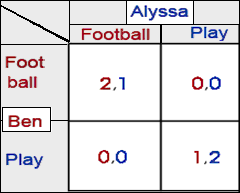
511_Nash Equilibrium.png

Please choose the right answer from above...I want your suggestion for the same.

   Related Questions in Game Theory

  • Q : Grim Strategy in Nash Equilibrium A

    A strategy combination where every player is playing a best response to other players' current strategies, and therefore has no incentive to change strategies in a repeating game is termed as: (1) zero-sum equilibrium. (2) the first mover advantage. (3) tit-for-tat. (

  • Q : Example of a noncooperative game An

    An example of a noncooperative game would be: (1) negotiations for international trade agreements. (2) collective bargaining. (3) plea bargaining. (4) the adoption of tit-for-tat strategies in repeated games. (5) collusion by firms in an oligopoly.

  • Q : NOT including competition in

    Illustrations of cooperative games do not comprise: (1) collective bargaining, in which the firms and unions bargain over employment. (2) international treaties that regulate trade. (3) pure competition. (4) plea bargaining between prosecutors and def

  • Q : Mugging is example of which problem A

    A mugging is an illustration of a: (1) positive-sum game. (2) negative-sum game. (3) zero-sum game. (4) predatory voluntary transfer payment. (5) tit-for-tat game. Hello guys I want your advice. Please recommend so

  • Q : Strategies of companies for Nash

    In this payoff matrix for the location strategies of companies: (w) BEST will choose to go to location 1 and ACE will choose to go to location 2. (x) BEST will choose to go to location 2 and ACE will choose to go to location 1. (y) there is no Nash equilibrium. (z) th

  • Q : Go to location of strategic companies

    In this payoff matrix for the location strategies of companies, when ACE fails to anticipate the response of BEST and when ACE locates first: (1) they will both go to location 1, just as they would have while BEST had located first. (2) ACE will go to location 1 and B

  • Q : Illustrate Dominant Strategy The

    The dominant strategies in this payoff matrix are for: (w) neither Venezuela nor Indonesia to cheat, thus ensuring that each gets $8 billion profit. (x) both Venezuela and Indonesia to cheat, so receiving $5 billion profit each. (y) the greatest payof

  • Q : Result of dilemma of prisoner When

    When Ack-Ack knows that Bongo has connections and will have him killed when he implicates Bongo, in that case the likely result is that: (1) neither prisoner confesses. (2) Bongo pursues a grim strategy. (3) Bongo will do less prison time than Ack-Ack. (4) both prison

  • Q : First Mover Strategy for Tit-for-Tat

    Jim shows Jena his homework as long as Jena permits him to look at her completed assignments, but when Jena stops demonstrating Jim her homework, Jim will not allowed her to see his. Jim's strategy is a: (1) a grim strategy. (2) tit-for-tat strategy. (3) first mover s

  • Q : Experience decreasing costs industry If

    If one industry’s development stimulates development in support and complementary industries, it permits firms within the industry to: (i) move up their rising long run average costs curves. (ii) sell their products for higher prices. (iii) focus old technologie