--%>

Result of dilemma of prisoner

When Ack-Ack knows that Bongo has connections and will have him killed when he implicates Bongo, in that case the likely result is that: (1) neither prisoner confesses. (2) Bongo pursues a grim strategy. (3) Bongo will do less prison time than Ack-Ack. (4) both prisoners confess. (5) Ack-Ack confesses but Bongo does not.
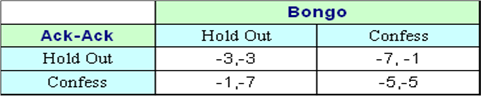
1166_Prisoners Dilemma.png

How can I solve my Economics problem? Please suggest me the correct answer.

   Related Questions in Game Theory

  • Q : Second Mover Strategy Assume that a car

    Assume that a car dealer tries to acquire a prospective buyer to “tell me your highest probable offer for this car, and we will see when that’s acceptable,” although a customer insists, “I will decide whether to buy after you make your lowest p

  • Q : Grim Strategy in Nash Equilibrium A

    A strategy combination where every player is playing a best response to other players' current strategies, and therefore has no incentive to change strategies in a repeating game is termed as: (1) zero-sum equilibrium. (2) the first mover advantage. (3) tit-for-tat. (

  • Q : Outcome for an infinitely repeated game

    One probable outcome for an infinitely repeated game is termed as the: (w) Middle East strategy. (x) tit-for-tat strategy. (y) echo strategy. (z) prisoners' dilemma strategy. How can I solve my Economics

  • Q : Illustration of a prisoner’s dilemma

    ACE and BEST are the only two grocery stores within a remote small town in North Dakota. There owners as each other very small, and trust each other even less. When they cooperate the Antitrust Division of the U.S. Department of Justice will never identify. That payof

  • Q : Illustrations of cooperative games An

    An instant of a noncooperative game would be: (w) consequences for non-confessors in a classic prisoner’s dilemma. (x) collective bargaining. (y) courtship and marriage. (z) plea bargaining. Can someone expla

  • Q : First Mover Advantage An aggressive

    An aggressive firm which initiates an action in a market most likely perceives a: (1) potential monopoly profit. (2) passive rival which will not react. (3) first mover advantage. (4) gain through a “counterpunch” strategy. (5) possibility

  • Q : NO net incentives to change current

    Rivals with no net incentives to modify their current strategies within a repeating sequence of games have arrived at a location of: (1) Nash equilibrium. (2) static churn. (3) classical steady state. (4) the invisible hand. (5) tactical impasse.

  • Q : Asymmetric Information If two firms

    If two firms considering a possible merger have unequal levels of knowledge regarding issues in their negotiations: (w) potential abuses of asymmetric information exist. (x) the payoff matrix is invariably asymmetric. (y) the more knowledgeable negotiator will gain by

  • Q : Example of Nash equilibrium In this

    In this payoff matrix as in demonstrated figure, when the wife gets to choose first: (w) she will watch the film and her husband will play golf. (x) she will play golf and her husband will go to the movies. (y) they will both play golf. (z) they will both go to the th

  • Q : Go to location of strategic companies

    In this payoff matrix for the location strategies of companies, when ACE fails to anticipate the response of BEST and when ACE locates first: (1) they will both go to location 1, just as they would have while BEST had located first. (2) ACE will go to location 1 and B