--%>

Explain reactions of carbonyl oxygen atom.

In these reaction oxygen atom of carbonyl group is replaced by either one divalent group or two monovalent groups.

Reaction by ammonia derivatives: aldehydes and ketones react with a number of ammonia derivatives such as hydroxylaminem hydrazine, semicarbazide etc. in weak acidic medium. In general, if we represent these derivatives by H2N-G, then their reaction with aldehydes and ketones can be represented as follows:

309_carbonyl.png 
 These derivatives are crystalline solids and having sharp melting and boiling points. Thus, they are used for the identification of carbonyl compounds. The various ammonia derivatives and their reaction products with carbonyl compounds are summarized in the same way.

The reactions of some aldehydes and ketones with ammonia derivatives are given below:

1451_carbonyl1.png     
Reaction by hydroxylamine: aldehydes and ketones react with hydroxylamine to give oximes.

The oximes can be hydrolysed back to aldehydes and ketones by reaction with acids. These can also be reduced to amines by reaction with Na, Mg, etc.
    
Reaction by hydrazine: aldehydes and ketones react with hydrazine to give hydrazones.
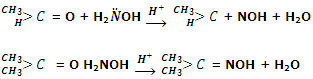
155_carbonyl2.png 
Reaction by phenylhydrazine: aldehydes and ketones react with phenylhydrazine to give phenylhydrazones.
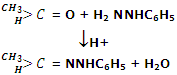
705_carbonyl4.png     
Reaction by 2, 4-Dinitrophenyl-hydrazine: aldehydes and ketones react with dinitro-phenylhydrazine to form 2, 4 dinitrophenyl-hydrazones commonly known as DNP or Brady's reagent.
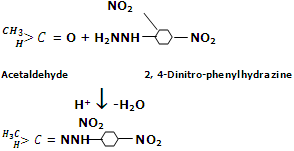
1131_carbonyl5.png


   Related Questions in Chemistry

  • Q : HCl polarity Illustrate HCl is polar or

    Illustrate HCl is polar or non-polar?

  • Q : Homework Silicon has three naturally

    Silicon has three naturally occurring isotopes. 28Si, mass = 27.976927; 29Si, mass = 28.976495; 30Si, mass = 29.973770 and 3.10% abundance. What is the abundance of 28Si?

  • Q : Vapour pressure of volatile substance

    Provide solution of this question. According to Raoult's law the relative lowering of vapour pressure of a solution of volatile substance is equal to: (a) Mole fraction of the solvent (b) Mole fraction of the solute (c) Weight percentage of a solute (d) Weight perc

  • Q : Distribution law Help me to go through

    Help me to go through this problem. The distribution law is applied for the distribution of basic acid between : (a) Water and ethyl alcohol (b) Water and amyl alcohol (c) Water and sulphuric acid (d) Water and liquor ammonia

  • Q : Molarity of solution Help me to go

    Help me to go through this problem. When 7.1gm Na2SO4 (molecular mass 142) dissolves in 100ml H2O , the molarity of the solution is: (a) 2.0 M (b) 1.0 M (c) 0.5 M (d) 0.05 M

  • Q : What is cannizaro reaction? Explain

    Aldehydes which do not have  -hydrogen atom, such as formaldehyte and benzaldehyte, when heated with concentrated (50%)alkali solutio

  • Q : What type of bond does HCl encompass

    What type of bond does HCl encompass? Describe briefly?

  • Q : Dipole attractions-London dispersion

    Describe how dipole attractions, London dispersion forces and the hydrogen bonding identical?

  • Q : What do you mean by the term dipole

    What do you mean by the term dipole moment? Briefly describe it.

  • Q : Problem on Osmotic Pressure of solution

    The osmotic pressure of a 5% solution of cane sugar at 150oC  is (mol. wt. of cane sugar = 342)(a) 4 atm (b) 3.4 atm (c) 5.07 atm (d) 2.45 atmAnswer: (c) Π = (5 x 0.0821 x 1000 x 423)/(342 x 100) = 5.07 atm