--%>

Problem on equilibrium constant

Ethanol is manufactured from carbon monoxide and hydrogen at 600 K and 20 bars according to the reaction

2 C0(g) + 4 H2(g) ↔ C2H5OH(g) + H2O (g)

The feed stream contains 60 mol% H2, 20 mol% CO and 20 mol% inerts.

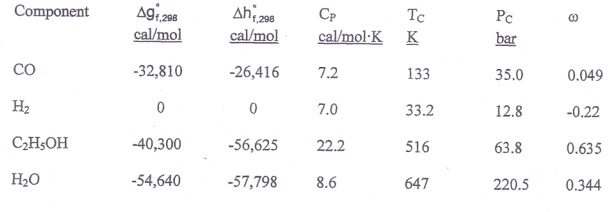
a) Using only the data presented below, calculate the equilibrium constant Kf at 600 K.

b) Calculate the maximum conversion of carbon monoxide that can be attained in the reactor using

i) the ideal gas model, and
ii) the Lewis-Randall's approximation.

Data:
1970_equilibrium constant.jpg

   Related Questions in Chemistry

  • Q : Reducible Representations The number of

    The number of times each irreducible representation occurs in a reducible representation can be calculated.Consider the C2v point group as described or Appendix C. you can see that (1) sum of

  • Q : Freezing point of equimolal aqueous

    The freezing point of equi-molal aqueous solution will be maximum for:            (a) C6H5NH3+Cl-(aniline hydrochloride)  (b) Ca(NO3

  • Q : Oxoacids of halogens Why oxidising

    Why oxidising character of oxoacids of halogens decreases as oxidation number increases?

  • Q : Infrared Adsorption The adsorption of

    The adsorption of infrared radiation by diatomic molecules increases the vibrational energy fo molecules and gives information about the force constant for the "spring" of the molecule.;The molecular motion that has the next larger energy level spacing aft

  • Q : Atmospheric pressure Give me answer of

    Give me answer of this question. The atmospheric pressure is sum of the: (a) Pressure of the biomolecules (b) Vapour pressure of atmospheric constituents (c) Vapour pressure of chemicals and vapour pressure of volatile (d) Pressure created on to atmospheric molecules

  • Q : Liquid surfaces The surface between a

    The surface between a liquid and a vapour distinguishes these fluids. The surface tension of liquids can be looked upon as that the property which draws a liquid together and forms a liquid vapour interface, therefore, distinguishing liquids from gases.<

  • Q : Hydroxide is highly insoluble in

     : 1) Chromium(III) hydroxide is highly insoluble in distilled water but dissolves readily in either acidic or basic solution. Briefly explain why the compound can dissolve in acidic or in basic but not in neutral solution. Write appropriate equations to

  • Q : Number of moles present in water

    Provide solution of this question. How many moles of water are present in 180 of water: (a)1 mole (b)18 mole (c)10 mole (d)100 mole

  • Q : Soluation of Ideal Gas Law problems

    Explain the method, how do you solve Ideal Gas Law problems?

  • Q : Particles of quartz Particles of quartz

    Particles of quartz are packed by:(i) Electrical attraction forces  (ii) Vander Waal's forces  (iii) Covalent bond forces  (iv) Strong electrostatic force of attraction Answer: (iii)