--%>

Divide total profit with profit maximization

Red Hat wants to raise the power of Linux to attract Windows all users. Therefore Microsoft is planning Windows Minus, a weaker version to compete along with Linux. All can sell low, medium or high powered versions of the new software, although each consequently should charge medium, higher, or lower prices for their software. When MS and RH could collude and divide their total profit in several fashions, joint profit maximization would arise with: (1) MS=high, RH = high. (2) MS=medium, RH=low. (3) MS=low, RH=high. (4) MS=high, RH=low. (5) MS=medium, RH=medium.
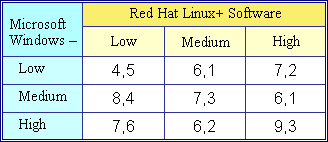
820_Nash Equilibrium1.png

How can I solve my Economics problem? Please suggest me the correct answer.

   Related Questions in Game Theory

  • Q : Decreasing cost industries When average

    When average production cost for Plastibristle Inc. falls like market demand increases and more firms go into the industry, Plastibristle is within:  (1) an economically efficient industry. (2) a purely competitive industry. (3) an industry exper

  • Q : Follow the Dominant Strategy Assuming

    Assuming that Venezuela and Indonesia both follow the dominant strategy as: (1) each will earn $8 billion in profit. (2) neither country will cheat. (3) both countries will do better when both cheat. (4) Venezuela will cheat and Indonesia will receive

  • Q : Problem regarding on positive-sum game

    International trade confronted by no tariffs or quotas therefore this is based upon comparative advantage is an example of a: (1) positive-sum game. (2) tit-for-tat game. (3) negative-sum game. (4) zero-sum game. (5) strategic game. Can anybody suggest me the proper expla

  • Q : Illustration of a prisoner’s dilemma

    ACE and BEST are the only two grocery stores within a remote small town in North Dakota. There owners as each other very small, and trust each other even less. When they cooperate the Antitrust Division of the U.S. Department of Justice will never identify. That payof

  • Q : Flip-flop Strategy in Game Theory

    Famous categories of strategic games do not comprise: (1) grim strategy. (2) tit-for-tat. (3) cooperative games. (4) flip-flop strategy. (5) first mover strategies. How can I solve my Economics pro

  • Q : Explain Nash equilibrium with an example

    In this payoff matrix as in illustrated, when the husband gets to choose first: (w) he will watch the film and his wife will play golf. (x) he will play golf and his wife will see the film. (y) they will both play golf. (z) they will both see the film.

    Q : Different charging in Nash equilibrium

    Red Hat wants to increase the power of Linux to attract Windows users. Microsoft is planning Windows Minus, a weaker version to compete with Linux. Each can sell low, medium, or high powered versions of the new software, but each consequently must charge higher, mediu

  • Q : Game Theory and Strategic Behavior Game

    Game theory focuses upon: (w) professional athletics. (x) strategic behavior among rivals. (y) competition among board game designers. (z) economic interpretations of political behavior. Hello guys I want your advi

  • Q : First Mover Advantage An aggressive

    An aggressive firm which initiates an action in a market most likely perceives a: (1) potential monopoly profit. (2) passive rival which will not react. (3) first mover advantage. (4) gain through a “counterpunch” strategy. (5) possibility

  • Q : Problem about Asymmetric Information A

    A large firm knows own costs and the costs of its rival. However a smaller rival firm knows its own costs although is unaware of costs of larger firm. The larger firm is likely to gain due to: (1) industrial concentration. (2) a dominant strategy. (3) predatory practi