--%>

Problem related to mass flow rate

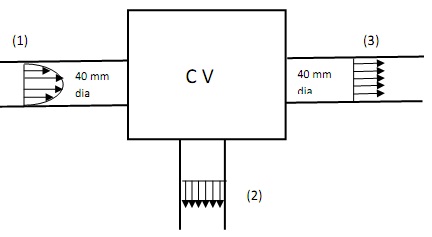
Water flows via a control volume as illustrated in the figure below. At Section (1) the diameter is 40 mm and the velocity profile is given by the V(r) = 10 (4 – r2) m/s, here r is the  distance from the centerline. At Section (2) the mass flow rate is 10 kg/s and at Section (3) the diameter is about 40 mm and the flow is uniform. Compute the uniform velocity at the section (3). The Density of water is taken as 1000 kg/m3
224_uniform velocity.jpg

   Related Questions in Mechanical Engineering

  • Q : Mechanical Systems Reliability -

    Mechanical Systems Reliability, MP3701 Your assignment must be submitted electronically via eLe

  • Q : Positive Displacement Type of Pump

    Explain why the Centrifugal Pump is not known as the Positive Displacement Type of Pump?

  • Q : Diesel Engine What will happen if the

    What will happen if the gasoline is used within the Diesel Engine, whether the Siesel Engine will work or not?

  • Q : Calculating liquid composition There

    There is a 35% MeOH/water mix to feed to a flash at 100 Ib- mole /hr and 1 atm. We want a vapour composition of 60 % MeOH. What does the vapour flow rate need to be? What is the liquid composition? Give the equation of the operation line?

    Q : Mechatronics Define the tem

    Define the tem Mechatronics and what are its elements?

  • Q : Problem on flow rates Water flows at 40

    Water flows at 40 m/s from the jet of area of cross-section of 0.008 m2 on to a flat plate as shown in the figure. Determine the force F normal to the plate, and also the flow rates out of the plate.

    Q : Rated Speed and Economic Speed Explain

    Explain difference between the Rated Speed and Economic Speed?

  • Q : Ergonomics in product design

    Ergonomics: This is concerned with how easy (comfort, complexity) the product is to use by the targeted market. Physical human dimensions must be considered when designing the driver's seating, instruments, and controls in a car. Slight variations bet

  • Q : Causes and consequences of dynamic

    Discuss the causes and consequences of dynamic loading on structures based on two real examples. Support your discussion with proper diagrams or sketches. Your discussion shall include the time and location of the event, type and source of dynamic loa

  • Q : Formation of Cavitation Explain the

    Explain the reason behind formation of the Cavitation in the Centrifugal Pump and not in the Displacement Pump?