--%>

Problem on augmented matrix

Consider the following system of linear equations.
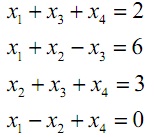
1415_augmented.jpg

 (a) Write out the augmented matrix for this system of linear equations.
 (b) Utilize elementary row operations to reduce augmented matrix to reduced row-echelon form.
 (c) Write out the answer to the system of linear equations.

   Related Questions in Mathematics

  • Q : Formal Logic It's a problem set, they

    It's a problem set, they are attached. it's related to Sider's book which is "Logic to philosophy" I attached the book too. I need it on feb22 but feb23 still work

  • Q : Formal logic It's a problem set, they

    It's a problem set, they are attached. it's related to Sider's book which is "Logic to philosophy" I attached the book too. I need it on feb22 but feb23 still work

  • Q : Explain Black–Scholes model Explain

    Explain Black–Scholes model.

  • Q : Explain the work and model proposed by

    Explain the work and model proposed by Richardson.

  • Q : Define terms Terms : Terms are defined

    Terms: Terms are defined inductively by the following clauses.               (i) Every individual variable and every individual constant is a term. (Such a term is called atom

  • Q : Use MS Excel to do the computations

    Select a dataset of your interest (preferably related to your company/job), containing one variable and atleast 100 data points. [Example: Annual profit figures of 100 companies for the last financial year]. Once you select the data, you should compute 4-5 summary sta

  • Q : Who firstly use the finite-difference

    Who firstly use the finite-difference method?

  • Q : Simulation with Arena An office of

    An office of state license bureau has two types of arrivals. Individuals interested in purchasing new plates are characterized to have inter-arrival times distributed as EXPO(6.8) and service times as TRIA(808, 13.7, 15.2); all times are in minutes. Individuals who want to renew or apply for a new d

  • Q : Where would we be without stochastic

    Where would we be without stochastic or Ito^ calculus?

  • Q : Abstract Algebra let a, b, c, d be

    let a, b, c, d be integers. Prove the following statements: (a) if a|b and b|c. (b) if a|b and ac|bd. (c) if d|a and d|b then d|(xa+yb) for any x, y EZ