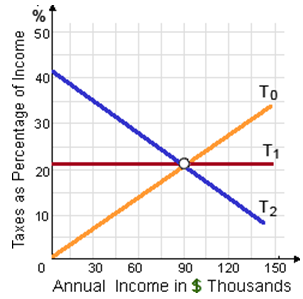
Define regressive in taxes as percentage of income
Line T2 depicts as in below graph a tax system which is: (i) progressive. (ii) recessive. (iii) proportional. (iv) biased. (v) regressive. How can I solve my economics problem? Please suggest me the correct answer.
Line T2 depicts as in below graph a tax system which is: (i) progressive. (ii) recessive. (iii) proportional. (iv) biased. (v) regressive.
How can I solve my economics problem? Please suggest me the correct answer.
When an NBA all-star bets in opposition to his team in games he plays after getting the money designated in his contract, he would be describing the problem of: (1) Default a version. (2) Over achievement. (3) Moral hazard. (4) Stupidity. Q : Equilibrium rent imposing price ceiling When the New York City government only permits landlords to charge $800 a month for a little apartment while equilibrium rent would be $1,500, this has imposed: (w) price floor. (x) regulation which will result in market surpluses. (y) regulation that
When the New York City government only permits landlords to charge $800 a month for a little apartment while equilibrium rent would be $1,500, this has imposed: (w) price floor. (x) regulation which will result in market surpluses. (y) regulation that
I have a problem in economics on Problem regarding Privatization. Please help me in the following question. The procedure of transforming government-run production facilities into ‘for-profit’ businesses is: (i) Privatization. (ii) Cartelization. (iii) Cap
The price elasticity of demand is considered as to be inelastic when the computed value is: (w) less than one although greater than zero. (x) greater than zero. (y) one. (z) zero. Hello guys I want your advice. Ple
The interest rate will probably fall when households decide to: (w) consume more currently, shrinking the loanable funds obtainable for business investments. (x) buy new homes in place of restoring their old ones. (y) increase the liquidity of their a
In the market of papayas: (1) A scarcity exists at P2. (2) Papayas are a free good at P0. (3) Papayas are presently a scarce good. (4) Consumer’s demand prices equivalent P2 at quantity Q2. (5) Equilibrium price for papayas be P0. Q : Advantages of free market economy Give Give the best advantages of free market economy?
Give the best advantages of free market economy?
Reliance on private demands and supplies to allocate resources and goods is least specific to yield an economically inefficient solution when: (i) producers have significant monopoly power. (ii) a good is nonrival and
Can someone please help me in finding out the accurate answer from the following question. The Accounting profits differ from economic profits in such a manner that: (1) Accounting profits take into account of opportunity costs, whereas economic profits take into acco
In short run, the supply of Pinot Noir from the viewpoints of oenophiles who fancy it would be influenced least by: (i) The offspring of late baby boomers arriving the legal age to buy alcohol. (ii) Imposition of a maximum tax for each and every bottle of wine generat
18,76,764
1927177 Asked
3,689
Active Tutors
1448439
Questions Answered
Start Excelling in your courses, Ask an Expert and get answers for your homework and assignments!!