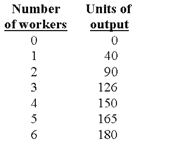
Problem on marginal returns
Select the right ans wer of the question. Refer to the following data. Diminishing marginal returns become evident with the addition of the: A) sixth worker B) fourth worker. C) third worker. D) second worker.
I have a problem in economics on Law of Demand in respect to relative price. Please help me in the following question. The law of demand defines that as: (1) Absolute prices rise, quantity demanded raises. (2) Relative prices raise, quantity demanded
In this market for textbooks, demand has transferred from D0 to D1 and supply varied from S0 to S1. Such market for textbooks has experienced as: (w) a raise in demand and supply. (x) a redu
The most important reform / revision of the welfare system within the past half century occurred throughout the administration of President as: (1) Richard Nixon [1971]. (2) Jimmy Carter [1978]. (3) Ronald Reagan [1984]. (4) Bill Clinton [1996]. (5) G
Total revenue for Macho Man fake mustaches increased after the price raised from $15 to $17, showing that demand faced throguh Macho Man was: (i) relatively elastic. (ii) relatively inelastic. (iii) unitarily elastic. (iv) perfectly elastic. (v) perfe
Even when each household’s demand curve didn’t shift, the market demand for the butter would increase if there were a raise in: (1) House-hold income. (2) People’s preferences for the butter. (3) Population. (4) Price of margarine.
Effects of price ceiling: The consequences of price ceiling might be: A) Scarcity of the commodity B) The government might oblige rationing that is, supply of goods in limited q
What do you mean by the Malthusian theory on population?
Copyright laws are least helpful in protecting the work of people who generate original: (i) lyrics and music. (ii) films. (iii) computer code. (iv) scientific theories. (v) poems or novels. How can I solve my Economics
From roughly 1890 till 1970 year, the “structure-conduct-performance paradigm” controlled theories regarding how firms behave in various types of markets. The term “structure” in this expression refers to such
The American workers tend to be much productive than their counterparts in the South America or Asia in part as they have: (i) Superior natural genetic endowments. (ii) Access to the better sports programming, that promotes the team-work. (iii) More capital to work wi
18,76,764
1946368 Asked
3,689
Active Tutors
1433389
Questions Answered
Start Excelling in your courses, Ask an Expert and get answers for your homework and assignments!!