--%>

Analytic time and profit maximization

Firm A in below illustration of figure maximizes profit and is: (1) demonstrated as operating in the long run. (2) capable of reaping economic profit of P2P1de, since only in the short run. (3) incurring economic losses equivalent to fixed costs of P3P2ef. (4) earning normal accounting profits, although only when it operates efficiently. (5) producing output level q5 to maximize total revenue.
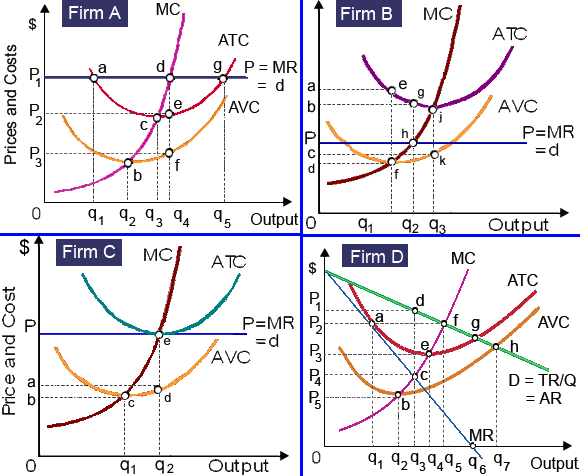
1317_Market Structures.png

Can anybody suggest me the proper explanation for given problem regarding Economics generally?

   Related Questions in Microeconomics

  • Q : Total costs incur by profit-maximizing

    Hybrid Roses is the merely florist in 60 miles of Presidio, Texas. When total fixed costs (for example, rent and utilities) are $9 per hour, that profit-maximizing monopolist will incur total costs of around: (w) $20 per hour. (x) $27

  • Q : Estimation of total cost in specific

    Total cost can be estimated as area: (i) 0bcq1. (ii) 0adq2. (iii) 0Peq2. (iv) aPed. (v) Cannot be measured in illustrated figure. 22</span></p>
                                        </div>
                                        <!-- /comment-box -->
                                    </li>
   
   </td>
	</tr><tr>
		<td>
       
      <li>
                                        <div class=

    Q : Problem regarding to tax wedges in

    In equilibrium, a tax upon a good tends to because of the: (1) supply to exceed the demand. (2) quantity supplied to exceed the quantity demanded. (3) demand prices of consumers to exceed the supply prices of sellers. (4) competitive

  • Q : Duopoly for two sellers What is that

    What is that market termed in which there are just two sellers (or firms)? Answer: Duopoly terms to a market condition in which there are only two sellers.

  • Q : Describe economic perspective The

    The economic perspective refer as: 1) macroeconomic phenomena, but not microeconomic phenomena. 2) microeconomic phenomena, but not macroeconomic phenomena. 3) the making of purposeful decisions in a context of marginal costs and marginal benefits. 4) unlimited resour

  • Q : Purely competitive seller in demand

    The demand curve facing a purely competitive seller is: (a) negatively sloped. (b) horizontal at the market price. (c) vertical at the market quantity. (d) the horizontal summation of all potential buyers’ individual demand curves. (e) market de

  • Q : Inferior Goods used in American family

    The most probable of the following to be an inferior good for most of the American families who buy some of each of such products would be: (i) Spam, that is a canned meat product. (ii) Plastic surgery. (iii) Concert tickets. (iv) Gasoline. (v) College textbooks.

  • Q : Maturity on a consol bond or perpetuity

    The yield to maturity on a consol bond or perpetuity which pays $200 annually and sells for $1000 is: (w) 5 percent. (x) 10 percent. (y) 20 percent. (z) 25 percent. I need a good answer on the topic of Econ

  • Q : Open Shop-union membership Firms which

    Firms which employ workers devoid of needing any form of either union membership or dues are the: (i) Agency shops. (ii) Laissez-faire shops. (iii) Union shops. (iv) Closed shops. (v) Open shops. Can someone please help me in findi

  • Q : Evalute clothing market Evalute the

    Evalute the statement. Generally People buy clothing in the city where they live. Therefore there is a clothing market in, say, Atlanta that is distinct from the clothing market in Los Angeles. This statement is tr