--%>

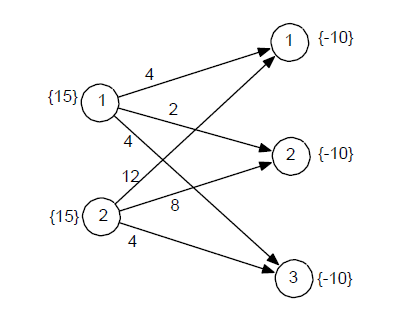
Use the NW corner rule to find an initial BFS


(a) Use the NW corner rule to find an initial BFS, then solve using the transportation simplex method. Indicate your optimal objective function value.

(b) Suppose we increase s1 from 15 to 16, and d3 from 10 to 11. Show that even though an extra unit is being shipped, the total shipping cost actually decreases by $2. Explain why increasing both supply and demand has resulted in a decreased solution cost by relating this phenomenon to the dual variables associated with supply node 1 and demand node


1825_Transportation_Problem.png

   Related Questions in Basic Statistics

  • Q : Problem on queuing diagram Draw a 

    Draw a queuing diagram for the systems below and describe them using Kendall’s notation: A) Single CPU system <

  • Q : Sample Questions in Graphical Solution

    Solved problems in Graphical Solution Procedure, sample assignments and homework Questions: Minimize Z = 10x1 + 4x2 Subject to

  • Q : Principles of data analysis For the

    For the data analysis project, you will address some questions that interest you with the statistical methodology we are learning in class. You choose the questions; you decide how to collect data; you do the analyses. The questions can address almost any topic,

  • Q : Cumulative Frequency and Relative

    Explain differences between Cumulative Frequency and Relative Frequency?

  • Q : Networks of queues Networks of queues •

    Networks of queues • Typically, the flow of customers/request through a system may involve a number of different processing nodes.– IP packets through a computer network– Orders through a manufactur

  • Q : What is Interactive Response Time Law

    Interactive Response Time Law: • R = (L/X) - Z• Applies to closed systems.• Z is the think time. The time elapsed since&nb

  • Q : Data Description 1. If the mean number

    1. If the mean number of hours of television watched by teenagers per week is 12 with a standard deviation of 2 hours, what proportion of teenagers watch 16 to 18 hours of TV a week? (Assume a normal distribution.) A. 2.1% B. 4.5% C. 0.3% D. 4.2% 2. The probability of an offender having a s

  • Q : Problems on ANOVA We are going to

    We are going to simulate an experiment where we are trying to see whether any of the four automated systems (labeled A, B, C, and D) that we use to produce our root beer result in a different specific gravity than any of the other systems. For this example, we would l

  • Q : Probability how can i calculate

    how can i calculate cumulative probabilities of survival

  • Q : State Littles Law Little’s Law : • L =

    Little’s Law: • L = λR = XR • Lq = λW = XW • Steady state system • Little’s Law holds as long as customers are not destroyed or&nbs