--%>

Short-run equilibrium of purely competitive industry

At the price P1, the given figure of purely competitive cranberry industry is within: (w) long-run equilibrium. (x) short-run equilibrium. (y) market period disequilibrium. (z) short-run disequilibrium.
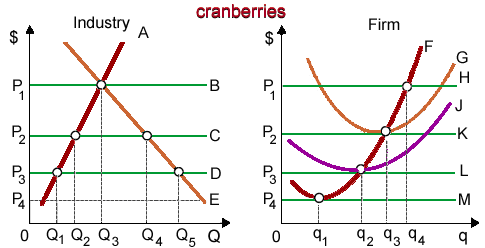
2157_demand and supply.png

Can someone explain/help me with best solution about problem of Economics...

   Related Questions in Microeconomics

  • Q : Facing a competitive firm more elastic

    The demand curve facing an unregulated non-discriminating monopolist is NOT: (w) similar as the industry's demand curve. (x) downward sloping. (y) more elastic than the demand curve facing a competitive firm. (z) various from its marg

  • Q : Problem on demand of rising exports

    Meager Russian grain harvests during the year 2001 led to increasing exports of U.S. grain to Russia, that symbolized a raise in the: (1) Demand for Russian grain. (2) Supply of U.S. grain. (3) Supply of Russian grain. (4) Demand for the U.S. grain.

    Q : Screening and Credentialism The critics

    The critics of ‘credentialism’ suppose that firms making employment decisions tend to mainly rely too heavily on: (i) Personal contacts. (ii) Personality testing. (iii) Past experience. (iv) Job interviews. (v) Formal education and trainin

  • Q : Arising of perfect price discrimination

    Perfect price discrimination would arise when a firm: (1) extracted full consumer surpluses from its customers. (2) permitted monopolistic customers quantity discounts. (3) redistributed real income among consumers. (4) inefficiently allocated its res

  • Q : Relation of transaction costs with

    Transaction costs are costs mainly related with the: (w) transportation and gathering information about goods or resources. (x) direct production costs for goods. (y) inputs quite than outputs. (z) supply prices rather than demand prices.

  • Q : When is marginal costs equivalent to

    A purely competitive firm adjusts production therefore its marginal costs equivalent the market price, thus: (w) minimizing losses or maximizing profit. (x) ensuring that total costs do not exceed total revenue. (y) surviving the shor

  • Q : Profit Maximization in Labor Markets

    Can someone help me in finding out the right answer from the given options. All the profit maximizing firms use labor up to the point where: (1) VMP = MFC. (2) VMP = w. (3) VMP = MRP. (4) MRP = MFC. (5) MR   MC is maximized.

  • Q : Production by a strategy of extensive

    Fakery is a pretentious start-up firm within the monopolistically-competitive costume jewellery industry. But Fakery is most probable to try to gain control over pricing whereas limiting its production by a strategy of: (1) lobbying C

  • Q : Competition in Labor Markets The

    The horizontal labor supply curve signifies that: (i) The supply of labor is perfectly inelastic. (ii) The firm can hire as much labor as it requires at going wage rate. (iii) Labor and capital are in the fixed supply. (iv) Marginal physical product of the labor is co

  • Q : Problem on Open Shops Whenever a firm

    Whenever a firm hires workers in spite of of whether the workers pay union dues, then this is: (i) A closed shop. (ii) A union shop. (iii) An agency shop. (iv) An open shop. (v) A scab shop. Choose the right answer from the above o