--%>

Cost structure characteristic in purely competitive industry

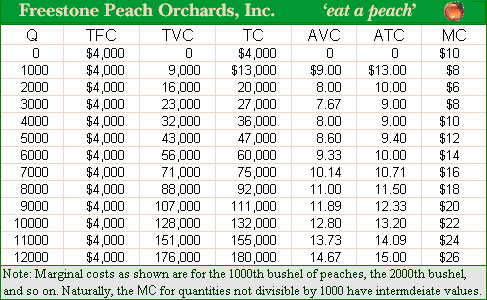
When Cling Peach Orchards has a cost structure characteristic of peach orchards into this purely competitive industry, when the long run new competitors would most likely enter the market providing the wholesale price per bushel of peaches exceeded: (i) $3.00 per bushel of peaches. (ii) $7.67 per bushel of peaches. (iii) $8.00 per bushel of peaches. (iv) $8.60 per bushel of peaches. (v) $9.00 per bushel of peaches.
770_Profits and Losses1.png

Hello guys I want your advice. Please recommend some views for above Economics problems.

   Related Questions in Microeconomics

  • Q : Markets in a capitalistic economy

    Markets within a capitalistic economy answer the “What?” question with: (1) government subsidies which promote new technologies. (2) giving those goods which consumers demand. (3) misleading advertising to persuade consumers to buy. (4) di

  • Q : Monopolist maximizes profit When a

    When a monopolist maximizes the profit in the product market, it will: (i) Hire labor till the marginal revenue product equivalents the marginal resource cost. (ii) Hire the labor till the value of marginal product equivalents the marginal resource cost. (iii) Pay a w

  • Q : Boosting total revenue by elastic price

    Price hikes for DVD games will boost total revenue providing the price is: (w) located on this demand curve. (x) above $30. (y) below $30. (z) below $25.

    Q : Indeterminable market supply curve For

    For a monopoly firm a market supply curve is: (w) steeper than the market supply curve of a competitive industry. (x) indeterminable because profit-maximizing quantities with profit maximizing prices are determined concurrently, and depend upon costs

  • Q : Changing effects of price of a product

    Increasing the price of a product will raise total revenue proportionally into the unlikely event which demand was: (1) perfectly price elastic. (2) relatively price elastic. (3) unitarily price elastic. (4) relatively price inelastic (5) perfectly price inelastic.

  • Q : Unite to form cartels and share

    Oligopolies which unite to form cartels and share monopoly profits give an illustration of: (i) collusive behavior. (ii) territorial imperatives. (iii) mergers and acquisitions. (iv) non-collusive strategy. (v) corporate raiding.

  • Q : Policies for overall demanding labor

    Policies which raise the overall demand for labor and maintain unemployment rates low are: (w) significant for the success of any other programs to reduce poverty. (x) sufficient measures to reduce the incidence of poverty. (y) not relevant to the suc

  • Q : Percentage of incomes persistently The

    The percentage of American families along with incomes persistently below the poverty line is around: (w) 1 2%. (x) 3 5%. (y) 5 7%. (z) 8 10%. Can anybody suggest me the proper explanation for given problem regardi

  • Q : Minimum Wage Laws and Monopsony Power

    The Minimum wage laws potentially raise both employment and wages if firms: (i) Have monopsony power in the labor market and don’t wage discriminate. (ii) Practice outsourcing across the international borders as labor costs abroad are lower. (iii) Are pure compe

  • Q : Split roughly burden of tax The burden

    The burden of an excise (i.e., per unit) tax would be divide roughly fifty by fifty on consumers and suppliers of the taxed good within: (w) Panel A. (x) Panel B. (y) Panel C. (z) Panel D.