--%>

Problem on mechanical efficiency of the pump

The oil pump is drawing 25 kW of electric power while pumping oil with ρ = 860 kg/m3 at a rate of 0.1 m3/s. The inlet and outlet diameters of the pipe are of 8 cm and 12 cm, respectively. When the pressure rise of oil in the pump is measured to be 250 kPa and the motor efficiency is 90%, then find out the mechanical efficiency of the pump. Taking kinetic energy correction factor to be 1.05.
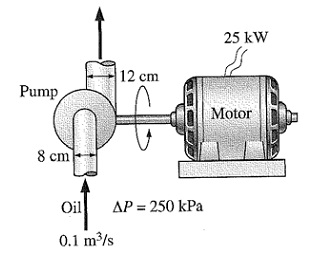
598_mechanical eff.jpg

E

Expert

Verified

Given:

Inlet Dia, Di = 8 cm = 8 x 10⁻² m
Outlet Dia, Do = 12cm = 12 x10-2m

Density of oil,  δ = 80Kg /m3

Flow rate Q = 0.1 m3/s

Pressure rise = 250KPa = 250 x10-3 Pa

Power supplied to the pump = 25Kw = 25 x 10-3 w

Motor efficiency = .90

Kinetic energy correction factor, α= 1.05

Inlet area Ai= Π/4 x D12=-Π/4 x (8 x 10-2)2 = 0.0804 m2
Outlet area A0= Π/4 x D02 = Π/4 x (12 x10-2)2= 0.1809 m2

Average evolution 
Vi = Q/Ai = 0.1/ 0.804 = 1.1235 m/s
V0 = Q/A0 = 0.1/ 0.1809 = 0.5526 m/s

A note of kinetic energy correction factor

K. E correction factor, α = (K. E /See based on actual velocity) / (K. E / See based on average velocity)

The factor α is used when the flow is viscous.

Applying Bernoulli’s equation at the inlet (i) i outlet (0) of the pump.

Pi/ δg + α1 Vi2/ 2g +zi + HP= P0 /δg +α2 Vo2/2g + Z0 + Hf .

Given  αi= α2= α= 1.05     (Z0 –Zi is considered negligible)
HP = head added by the pump
Hf = head loss due to friction

H= HP – Hf = P0–Pi / δg + α ( V02-V12)/ 2g
    = 250 x 103 / 1000 x 9.81 + 1.05 / 2 x 9.81 (0.55262  - 1.2435)
    = 25.42 m

Power of the pump PP= δg QH
            = 1000 x9.81x 0.1 25.42
            = 24934.85 w
            = 24.934Kw

Mechanical efficiency of the pump:

Case (1)  ηm = power output/power input = 24.934/ 25 = 99%
Case (2)  if the  motor is to get 25Kw  considering its efficiency  the supply should be of 25/ 0.9 KW

ηm = 24.934/ (25/0.9) = 89.67%

   Related Questions in Mechanical Engineering

  • Q : How do you repair a hydraulic jack How

    How do you repair a hydraulic jack?

  • Q : Problem on magnitude of force A

    A horizontal pipe of dimension 540 mm diameter carrying 0.6 m3/s splits into two horizontal pipes of 300 mm diameter with 60% of the flow and another of 150 mm diameter with 40% of the flow. Find out the magnitude and direction of the force

  • Q : Ergonomics in product design

    Ergonomics: This is concerned with how easy (comfort, complexity) the product is to use by the targeted market. Physical human dimensions must be considered when designing the driver's seating, instruments, and controls in a car. Slight variations bet

  • Q : Change of power in flow of kinetic

    Air at 20 m/s, 260 K, 75 kPa with 5 kg/s flows into a jet engine and it flows out at 500 m/s, 800 K, 75 kPa. What is the change (power) in flow of kinetic energy?

  • Q : Calculating liquid composition There

    There is a 35% MeOH/water mix to feed to a flash at 100 Ib- mole /hr and 1 atm. We want a vapour composition of 60 % MeOH. What does the vapour flow rate need to be? What is the liquid composition? Give the equation of the operation line?

    Q : Aim of an airspeed indicator in aircraft

    What is the main aim of an airspeed indicator in aircraft?

  • Q : Synchronous generator & Generating units

    Question 1: Three generating units operating in parallel at 60 Hz have rating of 300, 500, and 600    MW and have speed-droop characteristics of 5, 4, and 3%, respectively. Due to a change in load, a

  • Q : Problem related to pressure gauge Water

    Water flowing via the vertical pipe is illustrated below. Compute the required pipe diameter for the smaller pipe,‘d’,  given that the two pressure gauges read similar value.

    Q : Medium-sized turbine How pressure of

    How pressure of oil is managed when starting or stopping the medium-sized turbine?

  • Q : What is cotter joint Explain what is

    Explain what is meant by the Cotter joint?