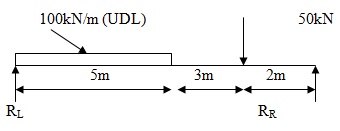
Problem on beam
For the beam illustrated below, we require to determine: (A) the support reactions RL and RR (B) the shear force and bending moment diagrams (C) the maximum stress in the beam due to bending.
For the beam illustrated below, we require to determine:
(A) the support reactions RL and RR (B) the shear force and bending moment diagrams (C) the maximum stress in the beam due to bending.
Refraction law: For a wave-front travelling via a boundary among two media, the first with a refractive index of n1, and the other with one of n2, the angle of incidence theta is associated to the angle of refraction phi by:
Bernoulli's equation - In an ir-rotational fluid, the sum of static pressure, the weight of the fluid per unit mass times the height and half of the density times the velocity squared is steady all through the fluid
Candela: The basic SI unit of luminous intensity stated as the luminous intensity in a given direction of a source which emits monochromatic photons of frequency 540 x 1012 Hz and encompasses a radiant intensity in the direction of 1/683 W/
Peltier effect (J.C.A. Peltier; 1834): The modification in temperature produced at a junction among the two dissimilar metals or semiconductors whenever an electric current passes through the junction.
Name the women scientist who played the essential role in the development of Missile technology of India and is nick named as the ‘Missile Woman’?
Mediocrity principle: The principle that there is nothing predominantly interesting about our position in space or time, or regarding ourselves. This principle most likely first made its real manifestation in the scientific community whenever Shapley
Equivalence principle: The fundamental postulate of Sir Einstein’s general theory of relativity that posits that acceleration is basically indistinguishable from the gravitational field. In another words, when you are in an elevator that is utte
Paschen series: The series that explains the emission spectrum of hydrogen whenever the electron is jumping to the third orbital. Each and every line is in the infrared part of the spectrum.
Is it possible to obtain the electron (or come out) from the nucleus?
State the law of Lamberts Cosine? Describe briefly?
18,76,764
1926371 Asked
3,689
Active Tutors
1461532
Questions Answered
Start Excelling in your courses, Ask an Expert and get answers for your homework and assignments!!