--%>

Maximum economic profit operates in new competitive firm

When this competitive firm operates at point d in demonstrated graph, in that case this: (w) could increase profits by expanding output to q5. (x) maximizes economic profit [ as area P2P1de], but these profits will evaporate in the long run as new firms enter the industry. (y) minimizes economic losses, that equal area P3P2ef. (z) experiences total fixed costs equal to area OP1dq4.
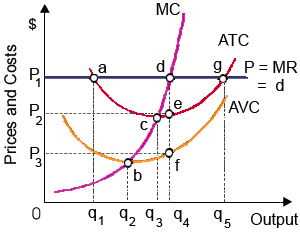
2452_Total Revenue1.png

Can someone explain/help me with best solution about problem of Economics...

   Related Questions in Microeconomics

  • Q : Higher prices and lower output in market

    When a previously competitive industry becomes monopolized along with no consequence on market demand or the structure of production costs, the effect will be: (w) higher prices and greater output. (x) lower prices and greater output.

  • Q : Problem on Closed Shops Can someone

    Can someone please help me in finding out the accurate answer from the following question. The firm which operates beneath a closed shop agreement: (i) Produces more gains than the firm beset through union strikes. (ii) Is less beneath organized labor's control than t

  • Q : NOT operating area of monopolistic firm

    Monopolistic competitors within long-run equilibrium do NOT operate where: is (1) MR = MC. (2) P = ATC. (3) P > MC. (4) MSB > MSC. (5) economic profits are realized. How can I solve my Economics

  • Q : Words of Joseph A. Schumpeter about

    According to Joseph A. Schumpeter as: (1) refined and popularized the idea that profits derive by innovation. (2) perceived profits as rewards for bearing uncertainty. (3) believed which monopoly firms are so inefficient which none fully realize their

  • Q : Collective bargaining agreement Provide

    Provide the solution of this question. A COLA is a clause in a collective bargaining agreement that: 1) specifies that one or more soft drink machines be available in each plant. 2) requires nonunion workers nevertheless to pay union dues. 3) automatically adjusts vac

  • Q : Law of Demand in respect to relative

    I have a problem in economics on Law of Demand in respect to relative price. Please help me in the following question. The law of demand defines that as: (1) Absolute prices rise, quantity demanded raises. (2) Relative prices raise, quantity demanded

  • Q : Exclusivity ratio of ratio while price

    The percentage change within quantity supplied divided through the percentage change within price is an approx measure of a good's: (w) unitary margin. (x) price elasticity of supply. (y) exclusivity ratio. (z) price elasticity of demand.

    Q : Price discrimination in the sale of a

    Price discrimination in the sale of a good show charging various prices that: (w) reflect differences in production costs. (x) do not reflect differences in production costs. (y) are dictated by market conditions. (z) cause a monopoly to be inefficien

  • Q : Preferance of food after income rises

    Assume that, for you, lobster is an ordinary good and peanut butter is a poorer good. When your income increases, you will probably consume: (1) Greater of both goods. (2) Less of both goods. (3) Greater peanut butter and less lobster. (4) Greater lobster and less pea

  • Q : Restricting output below competitive

    Below the competitive equilibrium output, restricting output will: (w) raise price above the competitive equilibrium price. (x) raise price above the marginal cost of the last unit produced. (y) generate a deadweight efficiency loss from underproducti