--%>

Demand of purely competitive firm for labor

This purely competitive firm’s demand as in given figure for labor corresponds to: (1) line segment ab. (2) line segment bd. (3) line segment be (4) line segment df. (5) line segment dg.
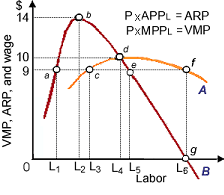
1605_Demand for Labor.png

How can I solve my Economics problem? Please suggest me the correct answer.

   Related Questions in Microeconomics

  • Q : Strategic Barriers to Entry in

    Extravagant and costly marketing through established firms in an oligopoly is probable to: (w) encourage entry by other profit maximizing firms. (x) raise the minimum efficient scale of production for new entrants. (y) act as a regulatory barrier of entry. (z) increas

  • Q : Interest Rate Reinvestment Risk Explain

    Explain the term Interest Rate Reinvestment Risk in detail?

  • Q : Joint Profit Maximization Joint profit

    Joint profit maximization is least compatible along with the behavior of: (w) General Motors’ division in Chevrolet, Cadillac, Hummer, Delco Remy and Frigidaire, etc. (x) a successful cartel as like OPEC. (y) a collusive agreement leading to sha

  • Q : Firms and the Transaction Costs Can

    Can someone help me in finding out the right answer from the given options. The survival of all firms eventually depends on the capability to: (i) Decrease transaction costs to consumers. (ii) Produce economic gain. (iii) Maximize the value of output for given cost. (

  • Q : Effect of supply curve due to price rise

    When a farmer grows wheat and rice, how will a raise in the price of wheat influence the supply curve of rice? Answer: The Supply curve of rice will shifted to the

  • Q : Purely competitive firm maximizing

    A purely competitive firm maximizes profit through producing where is: (w) P = ATC. (x) P = MR = MC. (y) PQ = TC. (z) AFC = AVC. I need a good answer on the topic of Economics problems. Please give

  • Q : Problem on national income Can someone

    Can someone help me in finding out the accurate answer from the given options. In short run, the demand for a normal good increases when: (i) Income become less uniformly distributed. (ii) The prices of complementary goods increase. (iii) National income mounts. (iv)

  • Q : Implication of price discrimination

    Price discrimination implies: (1) charging different prices for identical goods that have identical production costs. (2) paying wages based on race or sex quite than productivity. (3) exploiting the working masses by charging the highest single price

  • Q : Market supply Schedules for a good The

    The market supply schedule for a resource or good shows the: (i) Points in time if production is scheduled for completion. (ii) Amounts sellers wish could be given at prices exceeding the costs. (iii) Maximum quantities which will be offered for sale at particular pri

  • Q : Welfare Programs and Incentives The

    The incentive to work and earn income is probable to be greatest when the basic welfare benefit is ____ and the fundamental welfare benefit is reduced by ____ which the person earns. (w) high, the amount (x) low, the