--%>

Differences in the arc elasticities of demands

The dissimilarities in the arc elasticities of demands for labor among the Ajax Corporation and Bosun Limited are consistent along with an inference which Bosun: (1) is a more profitable firm than Ajax. (2) hires more highly skilled workers than Ajax does. (3) will grow quicker than the Ajax Corporation. (4) can most likely substitute capital for labor more productively than Ajax can. (5) produces output which sells for a higher price than Ajax’s product.
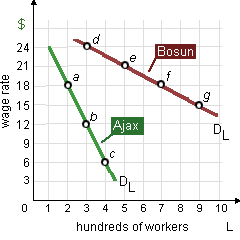
1045_Elasticity of the Demand for Labor.png

Can anybody suggest me the proper explanation for given problem regarding Economics generally?

   Related Questions in Microeconomics

  • Q : Concept of pure rent in economics Pure

    Pure economic profit is most closely associated to the concept of: (1) exploitation of labor. (2) opportunity cost. (3) pure rent. (4) pure oligopoly. (5) capitalization. I need a good answer on the topic of

  • Q : Holding less liquid assets in investment

    When households become more willing to hold less liquid assets, in that case the: (w) interest rate rises. (x) present value of future income falls. (y) interest rate falls. (z) stock market will crash. I need a go

  • Q : Copyrights in legal barriers to entry

    Legal barriers to entry do NOT comprise: (1) outright governmental prohibition of entry. (2) protection of inventions by patent. (3) licensing and bonding restrictions. (4) substantial economies of scale. (5) copyrights for music, computer software an

  • Q : Determine total revenue when prices fall

    As the price falls by P4 to P3 to P2 to P1 beside such demand curve for Pixie's cheesy fried grits, then total revenue: (w) always rises. (x) always falls. (y) rises then falls. (z) falls then rises.

    Q : Present Value and Rates of Return When

    When the annual interest rate is 12 percent and a rental house can be expected to rent perpetually for $1,000 monthly, rough computation suggests the house contain a present value of: (1) $240,000. (2) $144,000. (3) $100,000. (4) $72,000. (5) $12,000.

  • Q : Human Capital-Individuals premium wages

    The firm which offers its workers by substantial specific training tends to: (i) Pay such individuals premium wages to try to make sure retaining such workers. (ii) Need workers to sign the legal contracts of indenture and peonage. (iii) Raise worker productivity appr

  • Q : Conscious interdependence of oligopoly

    Firms that should contemplate the potential reactions of rival firms while adjusting their pricing and output to maximize long run profit are operating within an industry which is: (1) perfectly competitive. (2) purely competitive. (3) monopolisticall

  • Q : Estimate income elasticity of demand

    When Y = income, that is the income elasticity of demand is approximately measured when the value of: (i) (% change in Q) / (% change in Y). (ii) ratio of the slopes of demand relative to supply. (iii) (% change in Q) / (% change in P). (iv) constant

  • Q : Powerful firm confronted by powerful

    The model which examines the limits to bargaining among a powerful firm confronted by the powerful union is: (1) Bilateral monopoly model. (2) Pure monopsony model. (3) Convergence model. (4) Featherbedding model. (5) Keynesian cross model.

    Q : Sustained rates of economic development

    Sustained rates of economic development which exceeded population growth rates would: (w) raise the incomes of the poor without reducing anybody else’s income. (x) raise the incomes of everyone in society. (y) boost the incomes of the poor only