--%>

Market demand with market power

LoCalLoCarbo has turn into the favorite of fad dieters. There in illustrated graph curve B shows: (i) LoCalLoCarbo’s marginal cost curve. (ii) LoCalLoCarbo’s average variable cost curve. (iii) LoCalLoCarbo’s average total cost curve. (iv) the market demand curve facing LoCalLoCarbo. (v) LoCalLoCarbo’s marginal revenue curve.
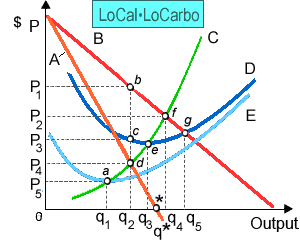
531_Market Power and Marginal Revenue.png

Can anybody suggest me the proper explanation for given problem regarding Economics generally?

   Related Questions in Microeconomics

  • Q : Constant-cost in short-run

    In a constant-cost, there purely-competitive industry in the short-run: (w) and long-run supply curves are positively sloped. (x) and long-run supply curves are negatively sloped. (y) and long-run supply curves are horizontal. (z) sup

  • Q : Discounted by an appropriate interest

    A fundamental principle of finance is that the net cash flows expected by an investment are: (w) all future revenues expected by the investment minus the purchase price of the capital. (x) negatively associated to the interest rates related with borrowing investment f

  • Q : Types of Cost Types of Cost : A) Direct

    Types of Cost: A) Direct costs: clearly chargeable to a work package: labour materials equipment other

    Q : Change in supply of good and in price

    When a change in the supply of a good causes a percentage change within price which exceeds in absolute value the resulting percentage change within quantity demanded, then demand is relatively: (1) price elastic. (2) inferior. (3) no

  • Q : Normative objectives for microeconomic

    Extensively accepted normative objectives for microeconomic comprise: (1) full employment and balanced economic development. (2) a stable price level and maximum purchasing power. (3) efficiency, equity and freedom. (4) job security and equality within the distributio

  • Q : Barriers prevent entry in monopoly

    Monopolists are more probable to generate economic profits within the long run than are pure competitors since: (w) monopolists are crooks. (x) monopolists are more interested in profits. (y) barriers prevent entry by new firms in a m

  • Q : Problem on Substitution effect for good

    One of my friend has a problem on substitution effect. The original equilibrium point (that is utility-maximizing bundle) in the graph shown below is at point A. The price of good Y is increased, pivoting the budget constraint down to its latest level.a. F

  • Q : Market Price in intervention Let’s take

    Let’s take a perfectly competitive market in which the market demand curve is provided by Qd = 20 − 2Pd and the market supply curve is provided by Qs = 2Ps. a) Determine the e

  • Q : Human Capital and Wage Differentials

    Relative to the equally strong, smart and hard working people with minimum education, the high school graduates who invest much heavily in more advanced formal education are probable to experience the lower average: (i) Wages whenever first enter the work force. (ii)

  • Q : Jurisdictional Strikes The Taft-Hartley

    The Taft-Hartley Act prohibited strikes against a firm over the issue of which of the two or more competing unions would symbolize the firm’s employees. These strikes are termed as: (i) Jurisdictional strikes. (ii) Strategic representation strikes. (iii) Wildcat