--%>

Market adjustments primarily in equilibrium condition

When the U.S. furniture market is primarily in equilibrium at point e upon S0D0 and in that case Chinese manufacturers begin exporting more furniture to the United States, that market would move in the direction of a new equilibrium at: (1) point a. (2) point b. (3) point c. (4) point d. (5) point f.
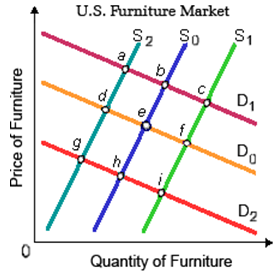
1498_Market shifting in equilibrium.png

Can anybody suggest me the proper explanation for given problem regarding Economics generally?

   Related Questions in Microeconomics

  • Q : Minimum Wage Laws-Group least likely to

    Can someone help me in finding out the right answer from the given options. The group which is least likely to be helped by the minimum wage law is: (1) African-American teenagers. (2) Skilled industrial workers. (3) Members of the unions. (4) Experienced construction

  • Q : Advantage of Law of Equal Marginal in

    Assume that the last week your food budget yielded 5 utils from your previous $4 burrito; and 4 utils from your previous $5 hot fudge sundae. Purchasing one: (i) More burrito and one less sundae this week would reduce total utility. (ii) More sundaes and one less burr

  • Q : Variation in demand and supply with

    It shifts within the demand for new textbooks from D0 to D1 may be a result of: (1) increased enrollments of students. (2) consumers' expectations of a future increase within the price of textbooks. (3) increased literacy rates. (4) increasingly efficient E-

  • Q : Difference among change in

    The difference between change in supply and change in quantity supplied is as follows: (1) The change in quantity supplied is caused just by the change in the price of good, whereas a change in supply takes place whenever the ceteris paribus suppositi

  • Q : Demand of Income elasticity for various

    Liz admitted a pay cut in May and consequently start cooking at home more and dining out less frequently. Her adjustments provide illustrations of the: (i) Substitution effect. (ii) Income elasticity of the demands for various goods. (iii) Law of diminishing marginal

  • Q : Short run expectations Can someone help

    Can someone help me in finding out the right answer from the given options. When Toyota expected the price at which it could sell its cars to increase in the near future, it’s very short-run response would possibly be to: (i) Raise its supply. (ii) Reduce its su

  • Q : Weekly economic profit of profit

    The profit maximizing firm currently here in illustrated graph can generate a weekly economic profit of approximately: (1) $29,000. (2) $31,500. (3) $34,000. (4) $36,500. (5) $39,000.

    Q : Occurrence of the price discrimination

    Price discrimination occurs when a good is: (1) priced by a formula yielding monopoly profit. (2) denied to customers who refuse to pay the going price. (3) sold at different prices not reflecting differences in costs. (4) subject to government price

  • Q : More elastic demand for labor The

    The demand for labor is more elastic the: (i) larger labor costs are like a proportion of total costs. (ii) shorter the time interval considered. (iii) greater the supply of labor. (iv) more difficult this is to substitute one resource for another. (v

  • Q : Moral Hazard-Policies of promotion Can

    Can someone help me in finding out the right answer from the given options. The Moral hazards which produce shirking by employees can be partly remedied when firms adopt the policies of: (1) Efficiency salaries. (2) Hierarchical signaling. (3) Careful screening throug