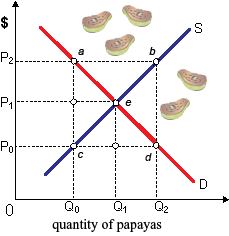
Shortages and surpluses in the market
A shortage as in below graph, during this market for papayas would match up to line: (1) ab. (2) cd. (3) ac. (4) bd. (5) ae. I need a good answer on the topic of Economic problems. Please give me your suggestion for the same by using above options.
A shortage as in below graph, during this market for papayas would match up to line: (1) ab. (2) cd. (3) ac. (4) bd. (5) ae.
I need a good answer on the topic of Economic problems. Please give me your suggestion for the same by using above options.
The best illustrations of monopoly power in the United States are possibly: (w) local public utility companies. (x) state university systems. (y) the national TV networks. (z) national defense firms. Hey friends pl
When brick-making is a constant cost industry, during the long run this firm is probable to experience: (i) a severe shrinking of economic profit to zero. (ii) a decline in the price of bricks to approximately eight cents apiece. (iii) increased compe
Outputs and average prices for CDs and DVDs both rose throughout 1999 to 2000 (just before file sharing became ordinary), implying such that: (1) supply of prerecorded music should have grown. (2) law of demand does not apply to music. (3) demand for
Both demand and supply of hamburgers would plummet in short run, as would be quantity sold, however we can’t be certain how the price would adjust when: (i) 75 % of the population became serious vegetarians. (ii) People abruptly decreased their intake of milk pr
Boosting minimum wage laws from $5 to $8 per hour is LEAST probable to: (w) give some unskilled workers with higher incomes. (x) cause some low-wage workers to lose their jobs. (y) raise friendship like a basis for employment. (z) decrease unemploymen
A monopolist will prevent operating within the long run unless its economic profit is: (i) zero. (ii) positive. (iii) greater than accounting profit. (iv) zero or greater. (v) zero or less. I need a good answer on
I have a problem in economics on Problem on blue collar workers. Please help me in the following question. The labor unions have tended to be very successful in organizing: (i) White collar workers. (ii) Blue collar workers. (iii) Professionals. (iv) Clerical workers.
Profit maximization needs a purely competitive firm to manufacture at an output level where: (i) marginal revenue > marginal cost. (ii) marginal cost equals the competitive price. (iii) marginal cost is falling. (iv) marginal reven
When Perpetual Motion Corporation’s recently-invented and patented teleporter buttons have no close substitutes, in that case Perpetual Motion operates: (1) along with absolute certainty of realizing a pure economic profit. (2) in violation of the laws of demand
The increase in the price of a good generally also rises the: (i) Demands for its substitutes. (ii) Supply of its complements. (iii) Purchasing power of the consumer incomes. (iv) Demand for its complements. Can someone please help
18,76,764
1928647 Asked
3,689
Active Tutors
1456341
Questions Answered
Start Excelling in your courses, Ask an Expert and get answers for your homework and assignments!!