--%>

Total costs incur by profit-maximizing monopolist

Hybrid Roses is the merely florist in 60 miles of Presidio, Texas. When total fixed costs (for example, rent and utilities) are $9 per hour, that profit-maximizing monopolist will incur total costs of around: (w) $20 per hour. (x) $27 per hour. (y) $34 per hour. (z) $49.50 per hour.
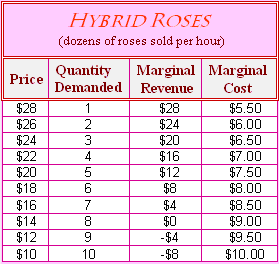
1957_Maximum Total Revenue.png

Hey friends please give your opinion for the problem of Economics that is given above.

   Related Questions in Microeconomics

  • Q : Problem on demand of rising exports

    Meager Russian grain harvests during the year 2001 led to increasing exports of U.S. grain to Russia, that symbolized a raise in the: (1) Demand for Russian grain. (2) Supply of U.S. grain. (3) Supply of Russian grain. (4) Demand for the U.S. grain.

    Q : Moral Hazard evidence Cameron is

    Cameron is performing a research project on whale migration at Pacific Ocean. To assist with this research she hires a Ph.D. from the MIT to make computer software to organize data, paying the software genius $150,000 for his services. The Ph.D. assures Cameron that t

  • Q : Another name of micro economics What is

    What is another name of micro economics? Answer: Price theory

  • Q : Road charging-an end to congestion

    ‘State the economic arguments on whether big cities which have congested roads must charge a road tax?’

  • Q : Economies of scale exist in range of

    Natural monopoly refers to a market or industry in that: (w) economies of scale exist across much of the complete range of market demand. (x) superior management enables a firm to remove its competitors. (y) a firm produces a good protected through pa

  • Q : Difference between Collusive and

    Difference between collusive and non-collusive oligopoly. Elucidate how oligopoly firms are interdependent in taking price and output decisions.

  • Q : Approximate unitary price elasticity of

    St. Valentine’s Day software is currently going addicted to version 6.0. The level of output consequent to the point where demand has unitary price elasticity is approximately: (i) 4 million copies. (ii) 6 million copies. (iii) 9 million copies.

  • Q : Higher interest rate in saving and

    A higher interest rate shows a: (w) stronger preference for current income over future income. (x) weaker preference for current income over future income. (y) stronger preference for future income over current income. (z) wave of pessimism among inve

  • Q : Problem regarding to price ceilings and

    Persistent shortages of a good are mostly all the time attributable to: (w) legal ceiling prices that are set below equilibrium. (x) recessions that yield high unemployment rates. (y) price gouging by firms with monopoly power. (z) legal price floors