--%>

Labor and Revenue in Purely Competitive Firm

Short run total revenue of the purely competitive firm would be at a maximum along with: (1) 600 workers. (2) 700 workers. (3) 800 workers. (4) 900 workers (5) 1000 workers.
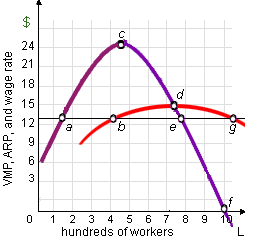
444_Problem on Demand for Labor.png

Can someone explain/help me with best solution about problem of Economics...

   Related Questions in Managerial Economics

  • Q : Purely competitive equilibrium labor

    When this purely competitive labor market is firstly in equilibrium at D0L, S0L, an increase within the price of output will result into equilibrium being attained at: (w) D0L, S0L. (x) D1L, S1L. (y) D2L, S1L. (z) D1L, S0L.

    Q : Gains from Exchange Can someone help me

    Can someone help me in finding out the right answer from the given options. Persons or nations that can outperform their competitors in all tasks enjoy: (1) Absolute benefits in all outputs. (2) Relative benefits in all outputs. (3) Comparative benefits in all outputs

  • Q : Difference between economics and

    What is the difference between economics and managerial Economic?

  • Q : Illustrates the environmental or

    Illustrates the environmental or external issues.

  • Q : Tax when price elasticity of

    When the ratio of the price elasticity of demand of a taxed good associate to its price elasticity of supply increases, tax is: (w) revenue will fall when tax rates are raised. (x) hikes will cause buyer's total outla

  • Q : Part of the payment in economic rent

    Economic rent shows part of the payment for the utilization of: (w) landowners’ labor and capital to keep their land. (x) landowners’ buildings and equipment. (y) resources for that supplies are less than perfectly elastic. (z) any piece o

  • Q : Explain about the control of business

    Explain about the control of business cycle.

  • Q : Investment in human capital in market

    Most economists would categorize the bulk of the funds spent upon your college education like: (1) an investment in human capital. (2) financial capitalization. (3) consumption. (4) specific training. (5) personal saving. Please gu

  • Q : Concavity in production possibilities

    Concavity (or bowed-out shapes) in production possibilities frontiers is described least fine by: (i) The law of diminishing returns. (ii) Resources being unevenly suited for various forms of production. (iii) Rising opportunity costs. (iv) Non-neutra

  • Q : Illustrates the conditions of price

    Illustrates the conditions of price discrimination?