--%>

Initially purely competitive labor market in equilibrium

When this purely competitive labor market is firstly into equilibrium at D0L, S0L, raise in labor productivity will result within equilibrium being attained at: (w) D0L, S0L. (x) D1L, S0L. (y) D0L, S1L. (z) D2L, S2L.
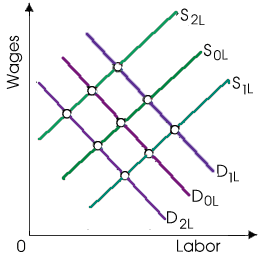
2005_Labor Market Equilibria.png

Hello guys I want your advice. Please recommend some views for above Economics problems.

   Related Questions in Managerial Economics

  • Q : Limitation for using illustrations of

    Illustrations of economic capital would NOT contain: (i) an accountant's computer. (ii) 1,000 shares of stock within Google. (iii) a sixteen-pound sledgehammer. (iv) tires upon an eighteen-wheeler truck. (v) paper into the printer of a romance novelis

  • Q : Human Capital Accumulation and the

    A society’s stock of human capital would be least probable to grow as a consequence of: (w) federal subsidies for college education. (x) sustained unemployment during a recession. (y) apprenticeship programs for construction workers. (z) retrain

  • Q : Wage rate at demand of labor When the

    When the wage rate price of $13, in that case this firm would hire slightly fewer than: (i) 600 workers. (ii) 700 workers. (iii) 800 workers. (iv) 900 workers (v) 1000 workers.

    Q : Illustrates the significance of

    Illustrates the significance of elasticity?

  • Q : Purely competitive labor market is

    When this purely competitive labor market is firstly in equilibrium at D0L, S0L, a move to equilibrium at D1L, S0L would be inconsistent along with increases in: (w) the price of output. (x) labor productivi

  • Q : Describe the term trend projection

    Describe the term trend projection.

  • Q : Explain the term relatively inelastic

    Explain the term relatively inelastic demand.

  • Q : Where managerial economics treat as a

    Where managerial economics treat as a tool? Answer: Managerial economics is like a tool for decision making and forward planning.

  • Q : Bend backward labor supplies Labor

    Labor supply curves “bend backward” within response to overwhelmingly powerful: (i) marginal effort effects. (ii) income effects. (iii) wealth effects. (iv) derived supply effects. (v) substitution effects.

    Q : Occurrence of Occupational Crowding An

    An illustration of occupational crowding occurs while: (1) Morgan, Blake and Jackie share one small office and a fax machine at an investment firm. (2) Juanita, Rosa, and Maria find work only as hotel maids since, as Hispanic women, they are stereotyp