--%>

Increases in labor force participation rates

When this purely competitive labor market is primarily in equilibrium at D0L, S0L, a move to equilibrium at D0L, S1L would be probably to follow from increases in: (w) rates of technological advance. (x) the cost of living. (y) labor force participation rates by workers along with the needed skills. (z) wage rates paid in a associated labor market.
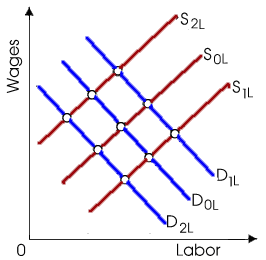
250_Labor Market Equilibria problem.png

Can someone explain/help me with best solution about problem of Economics...

   Related Questions in Managerial Economics

  • Q : Determine shape of total revenue curve

    Within a graph along with output on the horizontal axis and whole revenue on the vertical axis, determine the shape of the total revenue curve for a perfectly competitive seller: w) U-shaped. x) inverted U-shaped. y) a horizontal line

  • Q : Illustrates the Modern Definition

    Illustrates the Modern Definition?

  • Q : Additional unit in increasing real wage

    When the real wage raises, in that case an additional unit of: (w) labor supplied will buy fewer goods. (x) leisure is more expensive. (y) output need more labor time. (z) capital becomes more highly utilized. Can

  • Q : Illustrate profit or loss on the cost

    A firm's total profit can be computed as all of the given except w) total revenue minus total cost. x) average profit per unit times quantity sold. y) (price minus average total cost) multiply with times quantity sold. z) marginal profit times quantity sold.

  • Q : Determined equilibrium wage from the

    Within a purely competitive labor market, there the firm: (w) sets the wage that the household should accept. (x) should accept the wage demanded by the household. (y) and household arrive at the wage by bargaining. (z) and household should take the e

  • Q : Initially purely competitive labor

    When this purely competitive labor market is firstly into equilibrium at D0L, S0L, raise in labor productivity will result within equilibrium being attained at: (w) D0L, S0L. (x) D1L, S0L

  • Q : Tax when price elasticity of

    When the ratio of the price elasticity of demand of a taxed good associate to its price elasticity of supply increases, tax is: (w) revenue will fall when tax rates are raised. (x) hikes will cause buyer's total outla

  • Q : Unitarily inelastic supply of labor

    Glynn’s supply of labor is unitarily inelastic while the wage rate increases by: (1) $10 per hour to $20 per hour. (2) $10 per hour to $50 per hour. (3) $20 per hour to $50 per hour. (4) $20 per hour to $80 per hour. (5) $80 per hour to $90 per

  • Q : States the Demand Forecasting in terms

    States the Demand Forecasting in terms of production?

  • Q : Most exceed the wages or specific

    Firms tend to offer wages which most greatly exceed the wages which workers would earn elsewhere to workers who have: (1) profit-sharing plans. (2) specific training. (3) prenuptial agreements. (4) non-compete clauses in their work contracts. (5) general training.