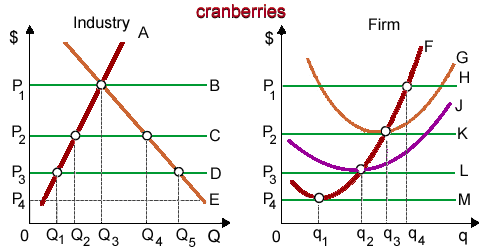
Equilibrium price in short run
The equilibrium prices for cranberries within the short run of: (w) P1. (x) P2. (y) P3. (z) P4. I need a good answer on the topic of Economics problems. Please give me your suggestion for the same by using above options.
The equilibrium prices for cranberries within the short run of: (w) P1. (x) P2. (y) P3. (z) P4.
I need a good answer on the topic of Economics problems. Please give me your suggestion for the same by using above options.
When firms or individuals attempt to personal gains or maximize profits or to minimize losses by trying to predict how other firms or individuals are probable to reaction, decisionmaking involves: (i) parallelism of action. (ii) profit maximization. (
In 1980 year, the chief executive officers that stand for CEOs of main corporations had income which averaged roughly 40 times as much as the workers they working. In 2005, such ratio is less than: (1) twenty to one. (2) forty to one. (3) one hundred
I have a problem in economics on Value of the Marginal Product. Please help me in the following question. Value of the marginal product is stated as: (1) MPP × P. (2) MPP × MR. (3) MPP × MC. (4) MPP × MRC. Q : Demand for loanable funds An increase An increase in the demand for loanable funds is reflected within an increase in the: (1) term structure of interest rates. (2) demand for money. (3) supply of bonds. (4) supply of money. (5) demand for bonds. I nee
An increase in the demand for loanable funds is reflected within an increase in the: (1) term structure of interest rates. (2) demand for money. (3) supply of bonds. (4) supply of money. (5) demand for bonds. I nee
The allocative inefficiency commonly related with the exercise of market [i.e., monopoly] power tends to be reduced when oligopolistic firms: (1) differentiate their products by competitive advertising. (2) price discriminate based upon the price elas
The labor monopsonist will hire labor up to the point where the marginal: (1) Revenue product of the labor equivalents the wage. (2) Resource cost of labor equivalents the salary. (3) Revenue product of labor equivalents its marginal resource cost. (4) Resource cost o
When you were unconcerned about the welfare of other people and your income rated you onto the top two percent of the population, then you would be happiest while the Lorenz curve for your country resembled as: (1) li
When the rate of return you calculate on an asset exceeds the interest rate: (1) competition for profit must make its price fall rapidly. (2) the price must fall rapidly. (3) the market is in long term equilibrium. (4) you should igno
Predatory behavior would not comprise: (w) lowering prices. (x) expanding output. (y) rapid technological innovation. (z) raising prices. Can anybody suggest me the proper explanation for given problem regarding
Does Europe and- USA or China have the greatest economy?
18,76,764
1934707 Asked
3,689
Active Tutors
1432733
Questions Answered
Start Excelling in your courses, Ask an Expert and get answers for your homework and assignments!!