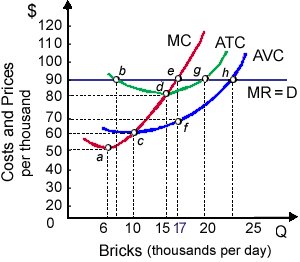
Approximate total revenue for profit-maximizing
For this profit-maximizing brickyard the total revenue equals approximately: (i) $600 per day. (ii) $900 per day. (iii) $1200 per day. (iv) $1530 per day. Hello guys I want your advice. Please recommend some views for above Economics problems.
For this profit-maximizing brickyard the total revenue equals approximately: (i) $600 per day. (ii) $900 per day. (iii) $1200 per day. (iv) $1530 per day.
Hello guys I want your advice. Please recommend some views for above Economics problems.
Can someone help me in finding out the right answer from the given options. Pam’s expectations that the costs of shoes are going to drop all through forthcoming clearance sales will lead, in the short run, to a/an: (i) Reduction in her demand for shoes. (ii) Red
When you were unconcerned about the welfare of other people and your income rated you onto the top two percent of the population, then you would be happiest while the Lorenz curve for your country resembled as: (1) li
Of the given firms, the best illustration of a natural monopoly is: (i) Dell, the largest seller of personal computers. (ii) Toyota, i.e., the huge car company in the world. (iii) OPEC, i.e., the international oil cartel. (iv) Google that dominates th
Concern regarding the quality of government is income elastic for mainly people that imply that higher incomes and prosperity tend to: (w) increase people’s participation in political processes. (x) reduce efforts to solve political problems. (y
When this profit-maximizing firm as in illustrated graph can’t price discriminate in that case this will operate where is: (1) accounting profit is positive but economic profit is zero. (2) the demand curve facing the firm is th
Assume that the domestic demand for television sets is explained by Q = 40,000 − 180P and that the supply is provided by Q = 20P. When televisions can be freely imported at a price of $160, then how many televisions would be generated in the domestic market? By
When you compute cross-elasticity of demand, what are you trying to find out? What do a negative coefficient and a positive coefficient imply?
At the point on the demand curve for RoboMaids where the price elasticity of demand is unitary, the price would be roughly: (i) $10,000, resulting in sales of roughly 16,000 robots monthly. (ii) $13,000, resulting in sales of approxim
The assumption essential for the result of the limit pricing model of strategic behavior is: (a) entrant firms price at marginal cost. (b) entry and exit is relatively costless. (c) the incumbent firms will maintain old output levels after entry of a
When the economy was in a complete equilibrium, in that case the distribution of income would be precisely proportional to the distribution of: (a) taxation. (b) inheritance. (c) luck. (d) wealth.
18,76,764
1929811 Asked
3,689
Active Tutors
1421701
Questions Answered
Start Excelling in your courses, Ask an Expert and get answers for your homework and assignments!!