--%>

Determine market demand in curve

The market demand curve as in demonstrated figure for Christmas trees is: (i) curve A. (ii) curve E. (iii) curve F. (iv) curve G. (v) curve J.
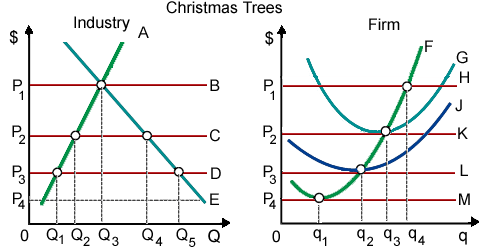
2057_supply and demand1.png

I need a good answer on the topic of Economics problems. Please give me your suggestion for the same by using above options.

   Related Questions in Microeconomics

  • Q : Lowering price of units selling A

    A monopolist which does not price discriminate faces a marginal revenue curve which slopes down quicker than its demand curve since: (w) economies of scale are significant. (x) selling more needs lowering the price of

  • Q : Total cost for monopolistic competitor

    Total cost for that monopolistic competitor in shown below figure equals area: (w) 0cbQ. (x) 0deQ + dcbe. (y) 0paQ   cpab. (z) All of the above.

    Q : Typical purely competitive firm in

    The typical purely competitive firm: (w) is both a price maker and a quantity adjuster. (x) operates within the inelastic range of the demand curve. (y) should decide how much to produce at prices set through the market. (z) tries to maximize total sa

  • Q : Explain about Welfare Recipients When

    When the ratio of [tax burdens upon you] / [taxes upon all taxpayers] is less than the ratio [benefits to you by government programs] / [benefits of government programs realized through all residents of the country], in that case it seems reasonable to explain you as

  • Q : Monopsonist-Wage discriminate Compared

    Compared with the price taker in labor market, the monopsonist which can’t wage discriminate will: (i) Hire more labor at any specified wage. (ii) Hire less labor at any wage. (iii) Pay a higher wage for any specified quantity of labor. (iv) Hire more prolific l

  • Q : World price in market When for wheat

    When for wheat the world price is $10 per bushel, and Del, who one owns the biggest wheat farm into North Dakota, will work at: (i) point a. (ii) point b. (iii) point c. (iv) point d. (v) point f.

    Q : Concentration ratio Explain the concept

    Explain the concept of a concentration ratio.  Is the concentration ratio in a monopolistically competitive industry likely to be higher than for a perfectly competitive industry

  • Q : Increases in market demand and resource

    If increases in market demand cause resource prices to raise, that resulting in higher average as well as marginal costs, an industry is: (i) experiencing diseconomies of scale. (ii) unprofitable in the long run. (iii) probably a natu

  • Q : Firm under perfect competition The firm

    The firm beneath perfect competition is a price taker by the reasons shown below:A) Number of firms: The number of firms beneath perfect competition is so big that no individual firm by changing sale, can cause an

  • Q : Labor Contracts of Check-off Provisions

    When a collective bargaining contract comprises a ‘check-off provision’: (1) Union workers can be fired when they don’t meet the production quotas. (2) Firms gather the union dues through deducting them from the paychecks. (3) Workers are needed to d