--%>

Determine equilibrium at changing price

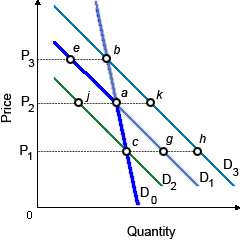
Within this kinked demand curve model, when this firm operated at point a and increased its price from P2 to P3 but other firms did not increase their prices, in that cases equilibrium for this firm would move to be: (w) point b. (x) point e. (y) point g. (z) point k.
1945_Kinked Demand Curves.png

Can someone explain/help me with best solution about problem of Economics...

   Related Questions in Microeconomics

  • Q : Computing economic profit To compute

    To compute the economic profit, it is essential to know the opportunity cost of: (i) Capital. (ii) Land. (iii) Labor. (iv) All the productive resources. Can someone please help me in finding out the accurate answer from the above o

  • Q : Avoid losses incurred from predatory

    To drive rivals by a market but ignore losses incurred by predatory pricing, a firm could: (w) cut price below costs but continue to sell similar amount of output. (x) set price equal to average costs, removing incentives for other firms to reenter th

  • Q : Perfect price elasticity in the short

    In a purely competitive industry, it tends to be perfect price elasticity within the short run: (w) market demand curve. (x) market supply curve. (y) demand for the good by a single consumer. (z) demand curve facing a single firm.

  • Q : Chance for arbitrage Normal 0 false

    Normal 0 false false

  • Q : Normal accounting profits in monopoly

    This monopoly makes Q units and experiences as: (1) economic profits equal to 0cbQ. (2) economic losses equal to cpab. (3) more than normal accounting profits. (4) marginal cost in excess of average total cost. (5) total revenue less than total cost.<

  • Q : Twin problems of the U.S. health care

    Give the answer of following question. The twin problems of the U.S. health care industry are: A) rapidly rising costs and unequal access to health care. B) declining quality of health care and the duplication of specialized equipment at hospitals. C) declining per ca

  • Q : Minor economic inefficiencies The minor

    The minor economic inefficiencies which monopolistically competitive firms may cause are as: (w) because of their inability to ever price discriminate. (x) a price which consumers pay for a greater range of slightly differentiated goods. (y) reflected

  • Q : Weekly economic profit of profit

    The profit maximizing firm currently here in illustrated graph can generate a weekly economic profit of approximately: (1) $29,000. (2) $31,500. (3) $34,000. (4) $36,500. (5) $39,000.

    Q : Present Value of a Perpetuity When the

    When the interest rate is 5%, in that case the present value of a perpetuity which pays $500 each year beginning a year by today equals: (1) $500. (2) $1000. (3) $2500. (4) $5000. (5) 10,000. Can s

  • Q : Labor Unions Strikes-Lockouts Can

    Can someone please help me in finding out the accurate answer from the following question. Whenever unions and managements have failed to arrive at a collective bargaining agreement and management closes the production facilities to exert pressure on the union negotia