--%>

Alpha's and Beta's profits

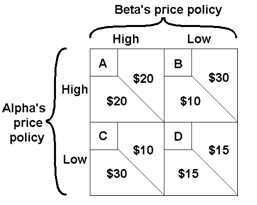
Refer to the below diagram where the numerical data illustrates profits in millions of dollars. Beta's profits are illustrated in the northeast corner and Alpha's profits in the southwest corner of each cell. If Alpha and Beta engage in collusion, the outcome of the game will be at cell: 1) A. 2) B. 3) C.  4) D.
678_jhhhhhk.png

   Related Questions in Microeconomics

  • Q : Long-Run Adjustments Since longer time

    Since longer time periods are considered and a bigger range of adjustments (or substitutions) become accessible, demand curves tend to become: (i) Flatter, whereas supply curves become steeper. (ii) Steeper whereas supply curves become flatter. (iii) Flatter, and ther

  • Q : Demand when price of good or resource

    When the price of a good or resource drops, the demands for: (i) That good or resource raise. (ii) Complementary goods or resources reduce. (iii) Substitute goods or resources reduce. (iv) Luxury goods and inferior resources drop.

  • Q : Goals of the Firm Most of the

    Most of the economists believe firms tend to proficiently maximize the profits since of: (i) Stockholder pressure. (ii) Competition for the management positions. (iii) Principal-agent conditions. (iv) The chance of corporate take-over.

    Q : Problem on perfectly competitive

    Can someone please help me in finding out the accurate answer from the following question. The profit-maximizing firm which is perfectly competitive in the resource market however which has the market power in output market will hire labor at a point where: (1) VMP =

  • Q : Determine demand and supply when

    If, throughout a period while video iPods are gaining popularity, the technology to create them enhances, in that case demand: (w) and supply would both decrease. (x) and supply would both increase.  (y) increases when supply decreases. (z) decreases when supply

  • Q : Profits predict by structure conduct

    When cost structures and market demands were identical for each of the given types of firms, in that case the structure-conduct-performance paradigm would predict the greatest profits for: (1) pure monopolist. (2) price-discriminating monopolist. (3)

  • Q : Quintile distribution of income Give

    Give the answer of following question. In the quintile distribution of income, the term "quintile" represents: A) 5 percent of the income receivers. B) 10 percent of the income receivers. C) 20 percent of the income receivers. D) 25 percent of the income receivers.

  • Q : Price elasticity of supply while the

    If John Whittler can sell totem poles for $1,800 at all, he markets 60 yearly, but while the price falls to $600 apiece; in that case he is willing to sell only 24 yearly. His price elasticity of supply is: (w) 0.43. (x) 0.86. (y) 1.62. (z) 2.48.

  • Q : Price discrimination in markets Price

    Price discrimination is probably in markets: (w) for medical services. (x) for wheat sold by farmers. (y) for bread sold by grocers. (z) where all consumers have identical demand curves. Can anybody suggest me the

  • Q : Price elasticity of demand coefficient

    Select the right ans wer of the question. The price elasticity of demand coefficient measures: 1) buyer responsiveness to price changes. 2) the extent to which a demand curve shifts as incomes change. 3) the slope of the demand curve. 4) how far business executives ca