--%>

Problem on motion of the system

(a) A plane moving at a constant velocity, V, crashes into a building as shown in figure below. Due to the design against plane crash of that building, neither major damage nor explosion occurs but the building vibrates after the crash. Assuming that the building can be modeled as a single degree of freedom system, derive the equation of motion of the system. Given that the plane and building become an entity after the crash, the mass of the plane is 10% of the mass of the building (m), the building has stiffness k and damping coefficient c. Determine the response of the building, u(t).
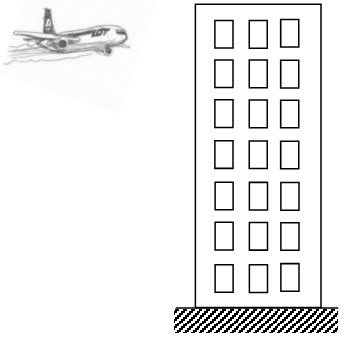
1640_plane.jpg

(b) You are given three options to modify the building as follows:

Option 1: Change m to 2m,
Option 2: Change c to 2c, and
Option 3: Change k to 2k.

Assess these three options and  find  the  option that will produce the minimum reaction of the building.

   Related Questions in Mechanical Engineering

  • Q : Problem on Ideal gas process A) Air at

    A) Air at 4MPa and 3000C enters a will insulated turbine operating at steady state with negligible velocity. The air expands to an exit pressure of 100KPa. The exit velocity and temperature are 90 m/s and 1000C respectively. The diameter of the e

  • Q : Formulating equation of motion Figure

    Figure below shows a reinforced concrete framed building subjected to earthquake ground motion. The floor is rigid with the mass of each floor is shown in the figure. Formulate the equation of motion for this building. Prove that the natural frequenci

  • Q : SI Engines Illustrate why several types

    Illustrate why several types of the sound are generated in different bikes, although they run on the SI Engines?

  • Q : Problem on discharge head loss Water is

    Water is draining from the tank A to tank B. The elevation difference among the two tanks is 10 m. The pipe joining the two tanks has a sudden-expansion section as shown below. The cross-sectional area of the pipe from A is 8 cm2, and the area of the pipe f

  • Q : Sources of energy what are different

    what are different alternate sources of energy

  • Q : Problem on head loss The pump

    The pump illustrated in the figure adds 20 kW of power to the flowing water. The only vital loss is that which takes place across the filter at the inlet of the pump. Find out the head loss for this filter. Note that the gage pressure upstream of the filter is negativ

  • Q : Problem on flow rates Water flows at 40

    Water flows at 40 m/s from the jet of area of cross-section of 0.008 m2 on to a flat plate as shown in the figure. Determine the force F normal to the plate, and also the flow rates out of the plate.

    Q : Formation of Cavitation Explain the

    Explain the reason behind formation of the Cavitation in the Centrifugal Pump and not in the Displacement Pump?

  • Q : Brazing and Welding Differentiate the

    Differentiate the term Brazing and Welding?

  • Q : Safe turbine operation For safe turbine

    For safe turbine operation how many governors are generally required and Why?