--%>

Problem on augmented matrix

Consider the following system of linear equations.
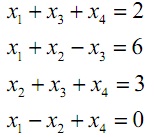
1415_augmented.jpg

 (a) Write out the augmented matrix for this system of linear equations.
 (b) Utilize elementary row operations to reduce augmented matrix to reduced row-echelon form.
 (c) Write out the answer to the system of linear equations.

   Related Questions in Mathematics

  • Q : Explain Factorisation by trial division

    Factorisation by trial division: The essential idea of factorisation by trial division is straightforward. Let n be a positive integer. We know that n is either prime or has a prime divisor less than or equal to √n. Therefore, if we divide n in

  • Q : Theorem-G satis es the right and left

    Let G be a group. (i) G satis es the right and left cancellation laws; that is, if a; b; x ≡ G, then ax = bx and xa = xb each imply that a = b. (ii) If g ≡ G, then (g-1)

  • Q : Graph Theory is the n-Dimensional Qn

    is the n-Dimensional Qn Hamiltonian? Prove tour answer

  • Q : Problem on mixed-strategy equilibrium

    Assume three Offices (A, B, & C) in downtown,  simultaneously decide whether to situate in a new Building. The payoff matrix is illustrated below. What is (are) the pure stratgy Nash equilibrium (or equilibria) and mixed-strtegy equilibrium of the game?

  • Q : Econ For every value of real GDP,

    For every value of real GDP, actual investment equals

  • Q : Problem on Datalog for defining

    The focus is on  the use of Datalog for defining properties  and queries on graphs. (a) Assume that P is some property of graphs  definable in the Datalog. Show that P is preserved beneath extensions  and homomo

  • Q : State Prime number theorem Prime number

    Prime number theorem: A big deal is known about the distribution of prime numbers and of the prime factors of a typical number. Most of the mathematics, although, is deep: while the results are often not too hard to state, the proofs are often diffic

  • Q : Row-echelon matrix Determine into which

    Determine into which of the following 3 kinds (A), (B) and (C) the matrices (a) to (e) beneath can be categorized:       Type (A): The matrix is in both reduced row-echelon form and row-echelon form. Type (B): The matrix

  • Q : Elasticity of Demand For the demand

    For the demand function D(p)=410-0.2p(^2), find the maximum revenue.

  • Q : Theorem-Group is unique and has unique

    Let (G; o) be a group. Then the identity of the group is unique and each element of the group has a unique inverse.In this proof, we will argue completely formally, including all the parentheses and all the occurrences of the group operation o. As we proce