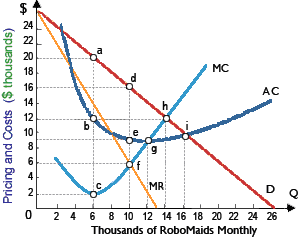
Estimate profit-maximizing price
The profit-maximizing price for RoboMaids is: (1) $24,000 per robot. (2) $20,000 per robot. (3) $16,000 per robot. (4) $12,000 per robot. (5) $10,000 per robot. Can someone explain/help me with best solution about problem of Economics...
The profit-maximizing price for RoboMaids is: (1) $24,000 per robot. (2) $20,000 per robot. (3) $16,000 per robot. (4) $12,000 per robot. (5) $10,000 per robot.
Can someone explain/help me with best solution about problem of Economics...
The supply and demand are affected by the time in sense that the longer the time interval considered, the: (1) Less sensitive sellers and buyers are to price changes. (2) Much sensitive sellers and buyers are to price changes. (3) Bigger is supply and
Marginal rate of Substitution (MRS): It is the rate at which a consumer is prepared to give up one good to get the other good.
Pure competitors in a long-run equilibrium are paid a price which: (i) allows recovery of any previous operating losses. (ii) equals MC although exceeds average cost. (iii) maximizes average revenue minus average cost. (iv) equals maximum long run ave
Babble-On maintains world-wide patents for software which translates any of 314 spoken languages into text, along with automatic audio and text translations into some of the other three-hundred-thirteen languages. Facing Babble-On the demand curve has unitary
When this firm is typical into this purely-competitive of constant-cost industry, as in demonstrated figure in long-run equilibrium for cranberries will be attained at a market price of: (i) P1. (ii) P2. (iii) P<
I have a problem in economics on Automation and Wage Rates. Please help me in the given question. When physical capital becomes cheaper: (i) Some of the workers might be displaced however worker productivity as a rule rises. (ii) Automation will
Price cross elasticity of demand measures the responsiveness of: (1) quantity of a good sold to changes within its price. (2) quantity sold to changes within income. (3) price of one good to changes within the sales of other. (4) amount demanded of on
Predatory behavior would not comprise: (w) lowering prices. (x) expanding output. (y) rapid technological innovation. (z) raising prices. Can anybody suggest me the proper explanation for given problem regarding
James and Louisa each have an income of $30, which they each spend on tomatoes and all other goods. They buy tomatoes at their local farmers market, which charges $3 per pound. Define the units for all other goods so that their price is $1 per unit.
One of my friends can't discover the solution of this question. So he is not capable to complete his assignment. Give answer of this question. Are there any limits or constraints onto the enterprise’s capability to grow and change?
18,76,764
1927767 Asked
3,689
Active Tutors
1415694
Questions Answered
Start Excelling in your courses, Ask an Expert and get answers for your homework and assignments!!