--%>

Demand for labor in competitive firm

Demand for labor of this purely competitive firm in given figure corresponds to: (1) line segment ab. (2) line segment bd. (3) line segment be (4) line segment df. (5) line segment dg.
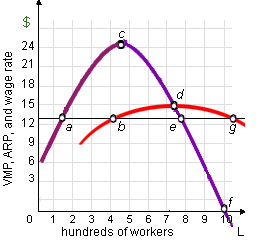
480_Problem on Demand for Labor.png

I need a good answer on the topic of Economics problems. Please give me your suggestion for the same by using above options.

   Related Questions in Managerial Economics

  • Q : Income effect of increase wage When the

    When the income effect of a wage raise is more powerful than the substitution effect, in that case the:  (i) labor supply curve will be “backward bending.” (ii) unemployment rate will rise since more people will be av

  • Q : Price of output in purely competitive

    When this purely competitive labor market is primarily in equilibrium at D0L, S0L, a moving step to equilibrium at D1L, S0L would be probably to follow from increases in: (w) imports of this good by foreign competitors. (x)

  • Q : Trade types of cycle distinguished by

    What are the trade types of cycle distinguished by Schumpeter?

  • Q : Highest income of supply of labor This

    This worker’s weekly income in this demonstrated figure would be the highest at: (w) point a. (x) point b. (y) point c. (z) point d. How can I solve my Economics problem? Please suggest me the correct answer.

  • Q : Unexpected increases in national income

    A firm is probably to reduce the number of workers this employs when there are: (i) reductions in the wage rate. (ii) increases in the price of the output. (iii) accumulations of specific training from workers. (iv) technological advances which encourage automation. (

  • Q : Use of Screening and Credentialism

    Critics of the wide use of screening and signaling within hiring practices argue which: (w) formal training is never very important in preparing workers with necessary skills. (x) worker credentials tend to be negatively related to productivity. (y) l

  • Q : Demad elacticty demand function is: QY

    demand function is: QY = -8,000 - 5,000PY + 192A + 120I + 2,000PX (6,000) (1,000) (120) (80) (800) R2 = 91% Here QY is quantity (measured in units) of Product Y demanded in the current period, A is hundreds of dollars of advertising ($00), I is thousands of dollars of disposable income per ca

  • Q : Maximizes profits of firm in a

    Refer to below figure. What is the amount of profit when the firm generates Q2units: w) this is equal to the vertical distance c to g. x) this is equal to the vertical distance c to Q2. y)  this is equal to the vertical distance g to Q2

  • Q : Explain about input output table method

    Explain about input output table method.

  • Q : Diminishing Returns and Increasing Costs

    I have a problem in economics on Diminishing Returns and Increasing Costs. Please help me in the following question. The concave (or bowed out) production possibilities frontier means that the opportunity costs are: (i) Constant (ii) Increasing (iii)