--%>

Maximizes profits of firm in a perfectly competitive market

Refer to below figure. What is the amount of profit when the firm generates Q2units: w) this is equal to the vertical distance c to g. x) this is equal to the vertical distance c to Q2. y)  this is equal to the vertical distance g to Q2. z) this is equal to the vertical distance c to g multiplied with Q2units.
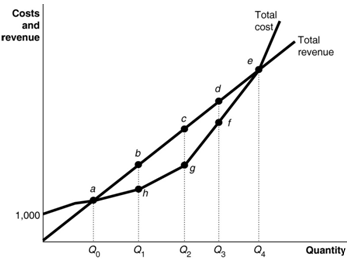
275_Maximizes profits of firm in a perfectly competitive market.png

Choose one option for the query by using the above shown figure.

   Related Questions in Managerial Economics

  • Q : Competitive demand of employer A

    A competitive demand of employer for labor is: (1) derived from the demand that exists for the firm’s output. (2) inverted compared to regular demands. (3) shifted rightward by hikes in real wage rates. (4) positively sloped. (4) determined thro

  • Q : Introduction of the term Margin of

    Provide a brief introduction of the term Margin of Safety?

  • Q : Describe the term Incremental Revenue

    Describe the term Incremental Revenue in details.

  • Q : Signaling and Screening Completing your

    Completing your degree is probably to be a significant signal which will help you secure a well-paid job along with a bright future if potential employer: (1) want to ensure that job applicants have already obtained important amounts of specific human capital. (2) use

  • Q : State Extrapolation statistical Method

    States the Extrapolation statistical Method of Demand Forecasting?

  • Q : Fundamental goal of maximizing in firms

    Economists suppose that firms hire labor to further a fundamental goal of maximizing: (1) economic profit. (2) workers’ welfare. (3) economy-wide employment. (4) managerial compensation. (5) the total value of output.

  • Q : Requirement of Screening Boris operates

    Boris operates a local landscaping company, needs each potential employee to lift a 200 pound tree before being hired whole-time. This obligation is an example of: (1) signaling. (2) discrimination. (3) screening. (4) derived demand. (5) automation.

    Q : Income effect at a wage rate The

    The substitution effect of a small change within the wage rate for this worker most strongly goes beyond the income effect at a wage rate of: (1) $5 per hour. (2) $10 per hour. (3) $10 per hour to $25 per hour. (4) $2

  • Q : Allocative and technical efficiency in

    Economy-extensive efficiency needs both allocative and technical efficiency within production and: (w) equity within the distribution of national income. (x) biological efficiency, in that people's basic desires should be met. (y) pol

  • Q : Profit Maximization and the Demand for

    An increase within competitively-set wages tends to cause firms to adjust hence there are reductions into the: (1) amounts of labor most firms hire. (2) value of the marginal productivity of workers. (3) marginal profit from hiring labor. (4) technolo