--%>

Price of output in purely competitive labor market

When this purely competitive labor market is primarily in equilibrium at D0L, S0L, a moving step to equilibrium at D1L, S0L would be probably to follow from increases in: (w) imports of this good by foreign competitors. (x) workers’ demands for greater leisure. (y) skill levels required to operate newly adopted technologies. (z) the price of output.
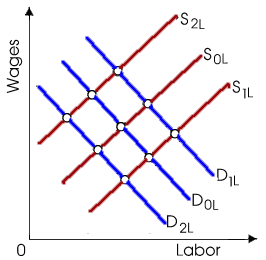
1965_Labor Market Equilibria problem.png

Please choose the right answer from above...I want your suggestion for the same.

   Related Questions in Managerial Economics

  • Q : Wage Rates and Marginal Resource Costs

    When all markets wherein a firm operates are purely competitive, in equilibrium the marginal resource cost of labor is the same to the: (w) firm’s marginal revenue. (x) marginal cost of output. (y) wage rate the firm must pay to hire more worker

  • Q : Illustrates the conditions of price

    Illustrates the conditions of price discrimination?

  • Q : Smoothing techniques or Exponential

    Explain about the term smoothing techniques.

  • Q : Explain managerial economics as a tool

    Does managerial economics as a tool for decision making? Explain this term.

  • Q : Competitive demand of employer A

    A competitive demand of employer for labor is: (1) derived from the demand that exists for the firm’s output. (2) inverted compared to regular demands. (3) shifted rightward by hikes in real wage rates. (4) positively sloped. (4) determined thro

  • Q : Fundamental goal of maximizing in firms

    Economists suppose that firms hire labor to further a fundamental goal of maximizing: (1) economic profit. (2) workers’ welfare. (3) economy-wide employment. (4) managerial compensation. (5) the total value of output.

  • Q : Illustrates the economies of scale are

    Illustrates the economies of scale are categorization?

  • Q : Derived Demands for Resources Demands

    Demands for resources are derived since they: (1) depend upon producers supplies of such resources. (2) depend on consumers demands for the goods the resources produce. (3) rely on the availability of suppliers. (4) rely on the industry’s demand

  • Q : Wage payments by total production cost

    Wage payments like a proportion of total production cost are positively associated to the: (1) ease of substitution between capital and labor. (2) wage elasticity of demand for labor. (3) extent of automation in the industry. (4) human capital created

  • Q : Different between Expert opinion and

    Illustrates the different between expert opinion method and trend projection method?